Wednesday, November 25, 2015

Mini-Review - "Frenzy" (1972)

Frenzy_movieposter

"Always make the audience suffer as much as possible." ~Alfred Hitchcock

Watching a Hitchcock film is like being dangled over the top of a twenty-story building - nerve-wracking, irritating, intense and nothing else like it in the world. Hitchcock is the one forcing you to look over the edge of that building and he enjoys every second of our torment.

The film to best personify that vision is Hitchcock's "Frenzy," a movie that came near the end of his career and saw him return to his British roots. By this point, the code of filmmaking that had been in place since Hitchcock arrived in America had been removed and replaced with the beginnings of the MPAA ratings. So Hitch took full advantage of that and that he was only bound by British filmmaking rules. He didn't seem to care if "Frenzy" got an R-rating, as long as it meant he could do anything he wanted, including opening his film with a naked dead body floating through London.

"Frenzy" is Hitchcock at his most barbaric, not afraid to pull any punches as to what can be shown on-screen. He'll show violent acts of passion and have the next scene be about the terrible cooking of a police chief's wife (which she never eats until the end, always forcing it on her husband). This is what makes "Frenzy" so endearing, the lighthearted nature of a serial killer on the loose in London and it works brilliantly.

"Frenzy" immediately differs itself from any other Hitchcock film with the amount of horrifying imagery throughout. Grotesque moments are implied in films like "Rear Window," "Vertigo" and "Shadow Of A Doubt," but we never see it in action. In the famous shower sequence in "Psycho," the knife is never shown cutting into the victim's skin and Hitchcock lets the audience paint the picture.

But with this one, nothing is left to the imagination and Hitchcock becomes brutal yet honest with the lengths this killer will go to.

The first half of "Frenzy" is spent following Richard Blaney (Jon Finch) and his unfortunate luck with women, jobs and race horses. Blaney becomes desperate for money and goes to his ex-wife for help. She is sympathetic but won't tolerate his anger and drinking habit, so she slips him some money and pushes him away. Not too long after that though, she ends up murdered by the "Necktie Killer" and all the signs point toward Blaney as the suspect.

In a way, the plot of "Frenzy" reminds me of "Psycho." The first hour of both films are drastically different from the second hour, always keeping you on your toes, never too sure what will happen to any of the characters. I can say I was pleasantly surprised by the final fifteen minutes of "Frenzy," because I did not see any of it coming. This film does a wonderful job of breaking away from the Hitchcock formula, while still having the flare of a Hitchcock masterpiece. Combine that with a great sense of humor and unforgiving cinematography, and you have the most underrated Hitchcock classic.

Final Grade: A-

Tuesday, November 24, 2015

Movie Review - "The Hunger Games: Mockingjay - Part 2" (2015) - Was Anybody Truly Hungry?

MV5BNjQzNDI2NTU1Ml5BMl5BanBnXkFtZTgwNTAyMDQ5NjE@__V1_SX214_AL_

And so the games come to an end. Not with a bang, but with a dream.

There has been a running theme throughout the previous "Hunger Games" films - being used by more powerful people to achieve their goals and collect more power. To be pawns in someone else's "games." Since the beginning, Katniss (Jennifer Lawrence) has been a tool for President Snow (Donald Sutherland) to keep his seat of power and control over the land of Panem, to remind the people who his way of life is what makes everyone else safe. But even when Katniss seems to break free of Snow's control, she falls into the palm of President Coin (Julianne Moore), and acts as the figure-head of her rebellion. Katniss thinks that she's fighting to take down Snow, when she's merely propagating Coin's agenda.

In the final installment of this franchise, "The Hunger Games: Mockingjay - Part 2," Katniss finally realizes that she is caught in the middle between the game of Snow and Coin, and wants to be able to think for herself. This makes the film less about ending a war, and more about finding yourself when all you've known is what someone else told you.

In this respect, Jennifer Lawrence nails her role and might have given her best performance in this franchise yet. While at times, Lawrence looks bored and uninterested, that might be on purpose. This is someone who had the role of "savior" thrust upon her, against her will, has seen thousands of people die for a cause that she doesn't fully believe in, and has been beaten down by the agenda of multiple presidents. This is a destroyed woman, who wants nothing more than to find a way out of all this, and the only way is to break free of all systems.

hunger-games-mockingjay-part-2-trailer-jennifer-lawrence

I've said in the past that the sole reason I was interested in the "Hunger Games" franchise was to watch Jennifer Lawrence continue to do what she does best - teeter on the edge of professionalism, eccentricity and insanity. I also said that this franchise was made to showcase Lawrence's talent as an actress.

While I still stand by that, the last film had me intrigued by the story more than anything. By this point, I already knew that Lawrence was going to astound me with her acting abilities. What I did not expect was the methodical disregard for sympathy, as Coin and Snow use every last drop of blood to play their chess game. It comes across like both had every last move planned out to the most minute detail, including the use of poison in flowers.

As always, Donald Sutherland as President Snow captures the duality of a man who takes pleasure in the pain of others, while always remaining composed and proper. Normally, this would be a role that was one scar away from being a Bond villain, but instead we get a man who has imposed his will upon others while making them think it was their thoughts. There is a point in this film that summarizes up Snow perfectly, coming near the end of the film, and we finally seem him cackle, as he believes the game has been won.

hunger-games-mockingjay

With all of that said, "The Hunger Games: Mockingjay - Part 2" has some problems.

The previous two films have built up this final act as an all-out assault, trying to take back the world and free it from the clutches of the evil Snow. Yet, there are roughly three sequences that make the film feel like a war. Outside of those scenes, this feels small and uninteresting.

At about the halfway point, our motley crew of teenage heroes have to fight a hoard of "Mutts," though they might as well be straight out of a zombie movie. While the build-up to this scene was fine, with nice pacing and atmosphere in the cramped sewers, the pay-off was severely lacking, as the action sequence that follows is blurry, dark and far too fast to keep track of that it is impossible to tell what is happening. While this might have been a pivotal scene in the book, it was an unimaginative and poorly executed scene in the movie.

president_snow_

Overall, I was impressed by the "Hunger Games" film franchise. Going into each of these films, I did not expect other than to make us lose our minds over Jennifer Lawrence losing her mind. But each film in this series has been wonderful at messing with my expectations and giving us something a bit removed from the Hollywood formula.

When the weakest film in your series is the first movie, you know that something went right.

Is this a perfect ending to the "Hunger Games" franchise? No, but it was certainly a satisfying one that may or may not have been left up to interpretation on the fate of Katniss. Like the previous two films, this one has terrifying performances from Lawrence and Sutherland, Kubrick-ian production design and cinematography and a gripping conclusion to the story of Katniss' fight to find herself in a world of lost people.

Final Grade: B-

Thursday, November 12, 2015

Movie Review - "Steve Jobs" (2015) - A Fallen Idol

MV5BMjE0NTA2MTEwOV5BMl5BanBnXkFtZTgwNzg4NzU2NjE@__V1_SX640_SY720_

To see the world through the eyes of an innovator is to see a bleak and often miserable existence. We might praise people like Albert Einstein and Martin Luther King Jr. now, but during while these fighters were in a constant struggle against not only their own demons but against society for daring to be different. Most of the people who change the world do not get their recognition until after their deaths.

I can honestly say I did not know who Steve Jobs was until after he passed away and everyone would not stop talking about how he changed the way we looked at computers and invited them into our home. That the digital age of social media, instant access information and handheld devices would not be possible without Steve Jobs. And after the release of his biography, which detailed his turmoil with Apple and his personal life, it only seemed natural to turn his life story into a film.

That is, after the disaster that was Asthon Kutcher's "Jobs."

Danny Boyle's "Steve Jobs" is a unique film-going experience that takes a vastly different approach to telling one man's life story while still capturing the essence of why this flawed creature is beloved and praised. Aaron Sorkin's writing shifts between pretentious and enlightening, but that is to be expected at this point. But Michael Fassbender's performance as Steve Jobs is what people are talking about, even if Fassbender can never reach the ego of this innovator.

The film details three key moments in Steve Jobs life - The reveal of the Macintosh shortly after the début of the "1984" Apple commercial, Steve's first independent creation of the NeXT computer in 1988, and his return to Apple with the creation of the iMac. Each of these takes place a few hours before Steve (Fassbender) showcases these products to the world, while we watch his life fall apart around him, including from Apple co-founder Steve Wozniak (Seth Rogan), the CEO of Apple John Sculley (Jeff Daniels), his personal assistant Joanna Hoffman (Kate Winslet) and Steve's daughter Lisa, who he constantly denies as his offspring.

kate-winslet

How you react to this movie will depend entirely on how you feel about Fassbender's performance.

While he nails the emotional scenes, realizing how much of a prick he can be to the people who care about him, there is a certain air to his performance. I never got the impression this was Steve Jobs, just Michael Fassbender pretending to be Steve Jobs. You might argue that is exactly what acting is, but great acting makes you forget the illusion of cinema and feel that you're watching real people, not just actors trying to be someone else.

I felt the performances from Seth Rogan, Jeff Daniels and Kate Winslet were emotionally-driven and often sympathetic to those who had to consistently deal with Steve Jobs. But it always felt like I was seeing Michael Fassbender flaunt his ego, and not become Steve Jobs. Perhaps this was because the man has become a legend by this point that it almost impossible for any actor to portray him.

screen-shot-2015-02-02-at-11-04-44-am

That being said, Fassbender made Steve Jobs vulnerable. He showed that this was a man who wanted to make something of himself in the world and took every opportunity to showcase that. Because he was so caught up in changing the world, he would neglect everything that any normal man would, like his daughter. This is a man so absorbed in his own ego that he is astonished that other people don't feel the same way about him.

Because of that, I can't say that Fassbender's performance was off-putting. It works perfectly for Aaron Sorkin's screenplay, even if he does not fully emulate Steve Jobs. From the moment of Fassbender denying that he has a daughter to the revelation of why Time magazine made his computer the "Man Of The Year" and not him, this is a noteworthy performance.

steve jobs

Overall, "Steve Jobs" is about a man so caught up in changing the world that he forgot to be apart of his own world. The visual style of Boyle's film matches this theme and character-arc for Jobs, as we watch his dreams become larger than life, then all fall apart, only to rise from the ashes and for the world to see him as he sees himself - an innovator.

Final Grade: B+

Wednesday, November 11, 2015

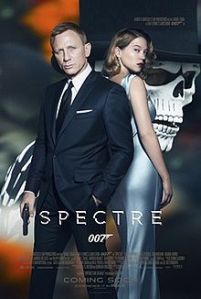
Movie Review - "Spectre" (2015) - A Tribute Worth Remembering

Spectre_poster

WARNING: SPOILERS AHEAD!!

Confession time - I'm not a big fan of James Bond.

To this day, I've only seen a few James Bond films, in particular "Goldfinger," "Dr. No," "Casino Royale," "Die Another Day" and "Skyfall." And while the two Daniel Craig Bond films I've seen have amazed, they have not made me want to see the other roughly 20 movies in the franchise.

It is like discovering the Godzilla franchise for the first time. You learn there are 30 films in the series, most of which aren't that great, and you're put off by a task so large that may not yield great results.

Even so, I'd still take Godzilla over James Bond. While Bond is the man who every man wants to be and every woman wants to be with, I could never get past his dead-pan reaction to every thing he encountered.

maxresdefault15

The building behind him blows up? Eh, it had it coming. The woman he was sleeping with is dead? That's a shame, have room service send me up another. Another assassin is after him? Is it Tuesday already?

I get that he is an assassin that has been desensitized to violence and crime over the years, but he has become so removed from reality that his childhood home blowing up gets little more than one quip out of him.

Do I hate the James Bond films? Not all. Like I said, I really enjoyed "Casino Royale" and "Skyfall," plus "Goldfinger" was action-packed and had a good sense of humor from Sean Connery. But I would not call myself a Bond fan, just someone who respects the franchise.

With that said, I also respect where the most recent Bond film, "Spectre" is coming from.
I've seen so many people bashing it for being boring, far too long and implausible, far removed from the realistic tone of the Daniel Craig films thus far. But "Spectre" was going for something much different from "Casino Royale" or "Quantum Of Solace," and that was to pay tribute to the older Bond films, like "Dr. No" and "Goldfinger." A film where the villain's plan is elaborate and convoluted, Bond is always grasping for even a moment's break, and the action is high and non-stop.

However, "Spectre" still has its share of problems.

Set shortly after the events of "Skyfall," James Bond (Daniel Craig) has been assigned one last mission by his former boss, to track down and kill a man who even his current boss, M (Ralph Finnes), has never heard of. What Bond finds though is a trail of bread crumbs leading him to a man who has been considered dead since James was a boy. This man, Franz Oberhauser (Christoph Waltz) has a plan for Agent 007, and intends to use his shady connections to ruin Bond's life.

FIRST-LOOK_post

There are several memorable scenes throughout "Spectre," and they all deal with convoluted action sequences that would make "Mad Max: Fury Road" blush. The opening sequence comes to mind, where a building collapses onto Bond, followed by a fist fight inside of a helicopter over Mexico City with the streets overflowing with bystanders, hoping that the blades come nowhere near them. I was blown away to see the helicopter fly upside down yet moves so smooth through the air, as if it had been launched off a ramp.

Not to mention, preceding that sequence was four-minute unbroken steady cam shot that followed James Bond from the streets, into a hotel, and to the rooftops of Mexico City. Seriously, opening your film with a long scene that is unedited is one of the best ways to get the audience's attention.

The chase sequence through the snow-capped mountains of Austria was also breath-taking, as the plane Bond uses slowly disintegrates and the kidnappers get further away. It was also a nice change of pace to see Bond doing the chasing and being in a vehicle normally associated with the villains. I think I heard people in the audience clapping at the end of this sequence, and it rightfully deserved that.

Spectre 1

That being said, that story of "Spectre" was nothing special and almost ruins the earlier Bond films. As it turns out, Christoph Waltz's character is actually Ernst Stavro Blofeld (complete with cat and scar across the eye) and he blames everything bad in his life on James Bond, and that he was the one who orchestrated villains like Le Chiffre in "Casino Royale" and Silva in "Skyfall," just to get back at Bond.

In other words, Le Chiffre didn't want to get out of the clutches of terrorists across the world or anything personal, but was all a puppet for Blofeld's needs. Silva didn't want revenge on M for abandoning him when he needed her the most, but was a tool to get back at James Bond, because Blofeld apparently had daddy issues.

I wouldn't have had a problem with this if Blofeld's reasons for hating Bond weren't so baffling - Blofeld's father adopted Bond after his parents died, and Bond "stole his father away from him." Waltz makes the comparison to a cuckoo, which throws out the babies of another bird's nest so that another set of parents will take care of it. Except that, based off the photos, Blofeld's father clearly spent time with him after adopting Bond, and the two were together in the accident that supposedly kill them.

And all the while, Bond has no reaction to any of this. He just found out that Blofeld killed the only woman he ever loved, sent a former agent to kill his boss, and he says nothing about substantial about it.

Up to that point, the story is one action set piece to another, in trying to get Bond to Blofeld. But once we get to the reason behind Spectre going all out in stopping James Bond, the plot goes all over the place, trying to wrap everything up nicely.

dc1

"Spectre" does not even take advantage of Christoph Waltz's talent, as he always speaks in a low tone of voice, unimpressed by anything. Even when torturing Bond, the man "responsible" for all his pain, he looks as though he'd rather be eating a sandwich. Waltz is at his best when he's living it up and having a great time taking advantage of other people's naivety and stupidity, which is absent in this role. That is unfortunate.

Overall though, "Spectre" was a blast. High on action and low on intelligence may be a different game than the previous Craig Bond movies play, but as a tribute to the Connery Bond films, this one pulls it off nicely. The story is a mess and the acting is not as crisp as it has been, especially from Waltz, but the action sequences are some of the best this year. This is not one of the best James Bond films, but it was certainly a fun one.

Final Grade: B-

Sunday, November 1, 2015

Movie Review - "Bridge Of Spies" (2015) - Spielberg, Hanks and Communists

MV5BMjIxOTI0MjU5NV5BMl5BanBnXkFtZTgwNzM4OTk4NTE@__V1_SX640_SY720_

Sometimes a films' greatest crime is being just average.

You never forget a truly great film, as Steven Spielberg has proven countless times and has done so since the mid-1970s. On the opposite end of the spectrum, a godawful film can leave a lasting impression on you. In place of excitement and awe with a great film is frustration and laughter in a bad film. Movies like "The Room" and "Plan 9 From Outer Space" might be glowing with faults and bad storytelling, but you remember how bad it was. You are reminded why you have standards and that these films don't hold up to them. They're entertainment of a different kind.

But a movie that falls in the middle is something else entirely. A movie that is neither good or bad has very little to remember about it. Scenes will come and go, do their job adequately so that you don't notice anything special but you don't question anything, and leave you feeling like nothing was gained or lost.

An average film is a forgettable film.

Tomhanks

Such is the case with Spielberg's newest film, "Bridge Of Spies." I would not say there is anything wrong with this film, as it does a fine job at keeping the suspense of the Cold War and does not stray from that. But nothing truly outstanding shines in this film either. It was a by-the-numbers spy thriller with a bit of courtroom drama thrown into the mix. While it does have the Spielberg style and has a captivating performance from Tom Hanks, that is about all "Bridge Of Spies" has to offer.

My favorite scene comes about an hour in, when a CIA agent is questioning Hanks' character about his actions - defending a known Soviet Union spy and pleading that he not be sent to the electric chair. Hanks brings up how he is Irish and that the agent must be German, but that what makes both American is that they believe in the Constitution - that all men are created equal and deserve to be treated as such, even known enemies.

Beyond that, not many scenes stuck out to me. I'm writing this hours after watching "Bridge Of Spies" and I can hardly remember any scenes. I recall the plot of a prison transfer during the Cold War and tense moments once Hanks moves the action to East Berlin, where the film takes on a "Schindler's List" feel, but the sense of atmosphere and focus is lost.
 
‘Bridge of Spies’ by DreamWorks Studios.

Overall, "Bridge Of Spies" is not bad at all, but is not impressive either. The performances from Tom Hanks and Mark Rylance as the Soviet spy are charismatic and pleasant, but everything is so mellow and calm about everything. It is like watching a debate between two men that respect each other - There might be some parts where they speak something profound, but they care too much about one another to raise their voice or question what they have to say.
 
Final Grade: C+

Friday, October 30, 2015

Movie Review - "Crimson Peak" (2015) - Gothic Horror At Its Finest

MV5BNTY2OTI5MjAyOV5BMl5BanBnXkFtZTgwNTkzMjQ0NDE@__V1_SX640_SY720_

One of the great points of living in the 21st century is having the widest range of learning and listening to other opinions and voices than any other point in history. Normally, you'd have to read about what others thought about a movie through your local newspaper or by reading a critic's book.

I bring this because I learned something about Guillermo Del Toro's most recent film "Crimson Peak" that I would not have known otherwise - That it is an homage to Italian horror cinema from the 1960s and 1970s. From the gothic landscapes, to excessive violence, to even outlandish plots that normally involve ghosts and spirits, "Crimson Peak" was meant to be a modern-day addition to those classic horror films.

Outside of Quentin Tarantino, it comes across like Guillermo Del Toro is the biggest movie buff in the film industry. Each of his films pay tribute to a genre that he adored, like "Pacific Rim" and the giant monster genre. His films emulate what makes those genres so great, while also making it accessible to those who may know nothing about these films. And "Crimson Peak" is no different, as long as you don't mind lots of violence and disturbing plot lines.

Set in the early 1900s, Edith Cushing (Mia Wasikowska) is a budding young writer in Buffalo, New York, but is haunted by the spirit of her mother, constantly warning her about "Crimson Peak," even though she's never heard of it. But when Sir Thomas Sharpe (Tom Hiddelston) visits, inquiring about funds for a project he is constructing back in England, Edith is infatuated by him and the two hit it off. After some strange looks from Thomas' sister, Lucille (Jessica Chastain), it seems like Edith will do anything to be near Thomas, even move back into his slowly disintegrating mansion across the pond.

Crimson-Peak-Tom-Mia

If you're going to watch "Crimson Peak" for anything, watch it for the visual style. Once the film reaches the mansion, the house takes on a life of its own. The house rests on top of a fine red clay, but this monument to time long since passed is so far gone that it is sinking into this muck, as if the house is bleeding. With every step these characters take, the clay oozes from underneath, and can almost always be seen coming out from a nearby wall. Anytime the water is turned on, the first bit of it is red.

It is as if the house has seen too much and is crying out in agony.

There is a gigantic hole in the middle of this mansion, where the seasons pass on the ground. Leafs fall below, even though there are no nearby trees, and a fine snow collects during the winter months. There are many scary aspects to "Crimson Peak," but the atmosphere alone is to die for.

crimson-peak-14-2-1500x844

I'm reminded of Tim Burton's "Sleepy Hallow," which was another tribute to a group of horror filmmakers - in that case, England's Hammer brothers. Both "Crimson Peak" and that film share a similar color palette, most characters and backgrounds are desaturated and look either pale or bleached, as if it had been out the sun too long.

But one color remains untouched - red.

"Crimson Peak" loves red and wants to showcase how bright and colorful it can be. Not just the clay or blood, but the many ghosts throughout the film are stained in red. Because everything else is so bland to look at, anything that is red stands out so much more. In a way, this is Guillermo Del Toro's most beautiful film so far.

crimson_peak_0_0

Like I said earlier, "Crimson Peak" is not a film for the faint-of-heart. They go into graphic detail on each ghost and how it got to looking like it did, and many of the characters do some despicably violent acts, with Lucille being the biggest culprit of them all. I won't go into detail, but let's just say I still feel dirty even after watching it. So if that makes you sick, this is not the film for you.

But if you like gothic horror tales of ghosts, ghouls and haunted mansions, as well as passion projects to a long forgotten form of cinema, then "Crimson Peak" is right up your alley. Though the film is short on story and does take a while to get going, there is no denying this is a visual thrill ride.

Final Grade: B

Tuesday, October 27, 2015

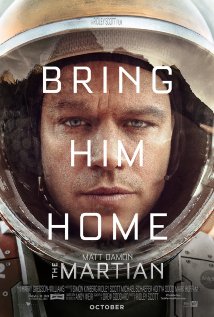
Movie Review - "The Martian" (2015) - Best. Mars. Movie. Ever.

martianposter

Much like Woody Allen, I have a love-hate relationship with Ridley Scott.

The problem with Scott is that he is inconsistent in his direction. One moment, he'll make a science fiction classic that took full advantage of its space horror scenario with "Alien," but then ruin it with "Prometheus" by wanting to be sophisticated, only to have it ruined by dumb character writing or logic gaps that make the audience question everything that has been built up.

I've made it no secret that I do not care for "Blade Runner," as that film has put me to sleep on more than one occasion. I also do not like "Gladiator," "American Gangster" or "Black Hawk Down," and despise Scott's version of "Robin Hood."

Part of the problem with Scott is that he seems to take a lot of fun out of going to the movies. His films are often visually stunning and go by the epic style of classic directors like Cecil B. DeMille and D.W. Griffith, but there is a general disconcern in his films. That everything is set up for one gigantic action piece, but never bother to ask how all these people got to this place and what their stake is in all of this.

In other words, Scott's films are all style, and no substance.

Which is why I adore Scott's newest film, "The Martian." While Scott does not diverge from his roots of making impossible landscapes feel so close to home, he does something that I have never seen out of Scott before - Telling an optimistic tale without any sort of violence or action set piece.

INTRO-2_20thCenturyFox_TheMartian

At times, "The Martian" feels like a fusion of "Gravity" and the worthwhile scenes of "Interstellar," where space is unforgiving and we are fools for trying to explore it. But then there are moments in "The Martian" that remind us why we explore space and the lengths we will reach to survive. That even in the face of overwhelming adversities, we will fight to see the sun rise one more day over that horizon. Even if that horizon is another planet.

On the space mission Ares III, one of the first missions to put astronauts on Mars, the crew encounters a large dust storm which forces them to abort the mission and leave the planet. Unfortunately, Mark Whatney (Matt Damon) is struck by debris on the way back to the ship and is declared dead by the crew, as they leave Mars without him.

As Earth and the crew of Ares III mourns the loss of Whatney, he awakens to find a piece of debris lodged in his chest and alive. After some surgery, Mark begins to realize his situation - Stranded on a deserted planet, with the closest rescue team being four years away, no way to contact NASA, and only has enough oxygen and food to last him a few months.

martianpotatoes

What I love about "The Martian" may seem rather simple, but is what makes going to movies so much fun. Mark, and not giving in to the inevitable and assuming that death will happen to him on Mars, decides to go against every odd and obstacle so that he will not die here. He is aware of the fact that everything seems against him, especially since no food grows on Mars and his rover can only go 30 minutes from base before needing a recharge. But that does not stop him from finding a solution to suit his needs.

All while, and this is the biggest reason this film works, Mark never once stops being positive about his struggle. He has his share of setbacks and fumbles along the way, but every day he finds a reason to smile and keep on finding a way home.

One of my favorite examples of this is after digging up a radioactive isotope, so that he can run the rover longer at night without using up the heater, Mark has found a song left by his commanding officer (Jessica Chastain) that is "the least disco," which is "Hot Stuff" by Donna Summers. He complains about how the only music he gets stuck with is crappy disco songs and still looks disapproving when the best song is still from the 1970s.

And yet, Mark grooves to the song anyway.

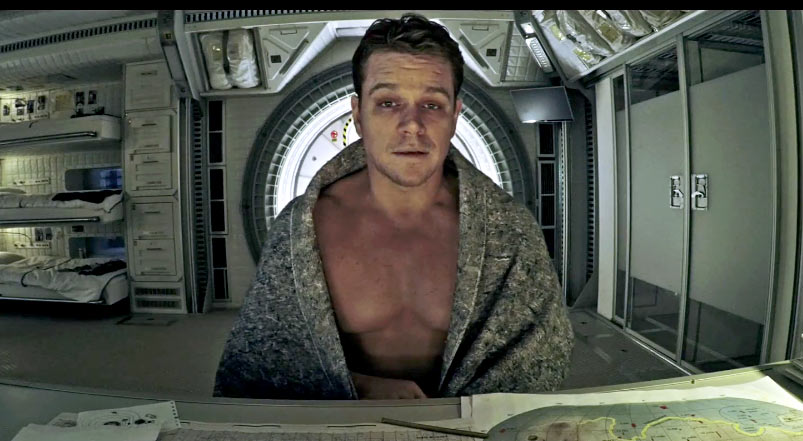
matt-damon-martian-trailer

To be perfectly honest, "The Martian" is not a complex movie about loneliness or the inevitability of death, though those are reoccurring points in the film. This is a survival film, about how we will not take something lying down and fight to survive anything that comes our way. It just so happens that Mark needs to survive on a planet that will kill you the moment your back is turned.

Matt Damon's performance as Mark Whatney is pitch perfect, as he captures both the highs and lows of a man being left for dead and refusing to take no for an answer. From cherishing the first time his potato crops grow in, to screaming at the top of his lungs when his bio-lab is destroyed by a breach in the tent, to posing for a picture like Fonzie from "Happy Days." Damon keeps this film grounded in reality, without ever going overboard on melodrama or psycho-analysis.

Mark is having a blast on Mars, because he loves the challenge of surviving something no one else has ever done before. He cracks his biggest smiles when he realizes that he colonized Mars and can add the title of "Space Pirate" to his list of accolades.

"The Martian" is one of those reasons why cinema is so much fun. It reminds us that the little moments of happiness can go a long way. That sometimes all you need is to be heart-warming, funny and strong-willed in order to be a beautiful film. Ridley Scott certainly surprised me with this film, but I am not complaining at all with the results.

Final Grade: A