Showing posts with label Mini-Reviews. Show all posts

Thursday, July 9, 2020

Mini Mini Reviews #2


“The Omega Man” (1971) – More or less, it’s a lame version of “The Last Man on Earth,” that exchanges all of its subtlety and tension for over the top goofiness and really poor effects. Grade: D+

“Moonstruck” (1987) – A very heartwarming romance with one of the more honest performances out of Nicholas Cage, while also proving how multi-talented Cher can be. Grade: B

“Cleopatra” (1963) – This should be the dictionary definition of extravagant and box office failure. The history behind “Cleopatra” is far more interesting than the movie itself, though that might be due to the four-and-a-half hour runtime. I wouldn’t have nearly as much problems with the film if it wasn’t the longest film I’ve ever watched and nothing about the film justifies that runtime. Grade: C

“The Death of Stalin” (2017) – A nice palette cleanser after “Cleopatra,” “The Death of Stalin” feels like the Russian equivalent of “Dr. Strangelove” focusing on incompetent idiots having to deal with problems they were never prepared for. Great dialogue, wonderful performances, and a hilarious pace that never lets up. Grade: B+

“Cornered” (1945) – A man travels to Argentina to find the Nazi who killed his wife, and the film utlimately becomes more about stopping that same Nazi from controlling some crime syndicate or something. It started out great and Dick Powell’s performance really captures the grief and pain he’s going through, but somewhere along the way the film loses its focus. Grade: C+


“Scoob!” (2020) – One of the best children’s movies in the last year, “Scoob!” is colorful, funny, loyal to the source material, and most importantly, fun. It takes Scooby-Doo to a more personal level than he’s ever been while still having a great sense of humor about it all. The opening is touching and the ensuing sequence where they remake one of the classic Scooby-Doo moments is great to see. Even though it’s aimed for little kids, there’s enough here for older fans of Scooby to enjoy this movie. Grade: B

“A Ghost Story” (2017) – Is it cliche to call this film haunting? One benefit I’ll give “A Ghost Story” is that, in the case of other thought-provoking indie films like “Under the Skin” I’d normally be bored out of my mind with so little happening in the film and even less pontificating. And while there are some annoyingly slow or nonsensical moments in “A Ghost Story,” the film really does drive home how distant, cold and worrisome death can be. It certainly has some bizarre artistic choices, but those choices do lead to a point that makes the whole piece worth it. Grade: C+

“Candyman” (1992) – This is a supernatural horror film way ahead of its time. Much like “The Twilight Zone,” “Candyman” uses myths and legends to talk about issues that plague society, and especially societies that often get unheard, especially in the 1990s. Wonderful writing, spectacular performances, some impressive cinematography, and horrifying effects, this one shows why the myth of Candyman has stuck with us for so long. Grade: A-

“I am a Fugitive from a Chain Gang” (1932) – For 1932, this film is as politically charged and controversial as Hollywood could be, taking a long, hard look at the dehumanization of the criminal justice system and how it defines those who have been in it. This film is brutally honest and horrifying for its time, but surprisingly thrilling, especially due to Paul Muni’s gripping performance as a man caught up in the mechanisms of a corrupt and petty form of justice, and how that changes him from the inside out. Grade: A+

“Horse Feathers” (1932) – Not the best Marx brothers comedy, but this one is certainly worth watching if only for the climatic football game where the brothers go all out. At times, it feels like a cartoon in how energetic and absurd they get. Grade: C+


“Gattaca” (1997) – A thought-provoking piece of speculative fiction, “Gattaca” explores every aspect of how humanity would change if we went all in on the genetic manipulation, both the good and the bad, especially how that would make the best of us possible but also create a new form of descrimination against those who didn’t have their genetics changed. It’s an effective triumphant story, sold by Ethan Hawke’s emotional performance, with some eye-opening world building. Grade: B+

“The Yearling” (1946) – This is your standard, run-of-the-mill boy and his dog story, except that it’s a baby deer instead of a dog, complete with a coming-of-age story about the boy fighting for his home and growing up a little faster than expected. The best part is certainly the boy’s father, played by Gregory Peck, who has the same likable charm we’ve come to admire from him in works like “To Kill A Mockingbird” and “Roman Holiday.” Grade: C

“Murder by Contract” (1958) – This is a barebones film noir about a hitman with a strict code that he adheres to, with a strange sense of superiority that gives him a rather cool edge. Aside from a memorable soundtrack and the coolness of the main character, this is your basic film noir. Grade: C+

“Da 5 Bloods” (2020) – Describing “Da 5 Bloods” as a strange mix of “Do the Right Thing,” “Apocalypse Now” and “The Treasure of the Sierra Madre” would not do this film justice. Much like all of Spike Lee’s best work, this film captures a great pain that is timeless in its relevance, in this case the mistreatment of black soldiers during the Vietnam War and how situations have not improved much since then. Most of this is sold through the tortured performance of Delroy Lindo, a man teetering on the edge of clarity and insanity, and a brilliant fusion of Fred C. Dobbs and Colonel Kurtz. It is eye-opening, impactful, thrilling, visually stunning, and it is Spike Lee in his element. Grade: A

“Underworld U.S.A.” (1961) – If “Mildred Pierce” is the perfect Mother’s Day film noir, then “Underworld U.S.A.” is the perfect Father’s Day noir, about how far one man will go to avenge his old man. What really hits home is that, while we never get to see the father alive, we see just how much he impacts our protagonist (Cliff Robertson) in his day-to-day life, making this a tribute to how much a father influences his son’s life in invisible ways. Grade: B


“San Francisco” (1936) – Aside from the spectacularly executed earthquake special effects and model use that followed that scene, nothing too extraordinary about “San Francisco.” Other than wanting to slap Clark Cable for being the most insensitive, smug, selfish prick on the planet, and that apparently D.W. Griffith co-directed it, which would probably explain why the film wants us to sympathize with the most unlikable man on the planet. Grade: C

“Tokyo Godfathers” (2003) – “San Francisco” could have learned a thing or two from this movie about taking characters that should be unlikable or despised and giving them dimensions, trauma and redemption. Everything about this movie flows together so perfectly, especially the broken homeless family healing each other through actions even they didn’t know they had in themselves. Grade: A-

“A Matter of Life and Death” (1946) – The best way I can describe “A Matter of Life and Death” is as a reverse “Wizard of Oz,” where real life is filled with bright technicolor and new opportunities to explore and love, and the fantastical is shot in black-and-white and is shown to be a dreary, monotonous bureaucracy. If you enjoy “Wizard of Oz,” you should definitely give this one a try. Grade: A-

“The Loneliness of the Long Distance Runner” (1962) – Certainly the most angsty, rebellious British film I’ve ever seen. It shows a darker, more honest look at the impoverished side of Britain and the hardships that those people carry. Grade: C+

“I was a Male War Bride” (1949) – One of the better examples of a love-hate relationship I’ve seen in Hollywood movies, where both partners (played by Cary Grant and Ann Sheridan) constantly try to one-up each other in the most showoff-y way possible, which gets on the other’s nerves, while always going out of their way to help the other whenever possible. It is odd that the titular plot of the film, about Cary Grant having to pose as a war bride, only comes in the last 40 minutes, but this light screwball comedy still works throughout. Grade: B


“Chariots of Fire” (1981) – On the complete opposite end of the spectrum from “Loneliness of the Long Distance Runner,” this film is all about proper Englishmen and devotion to that prim and elegant lifestyle above all else. Still, the most interesting thing about “Chariots of Fire” was the soundtrack, mostly because the electronic 80s music feels so strange when used for a film set in the 1920s. Grade: B-

“Earth vs. the Flying Saucers” (1956) – What pushes this film above other 1950s sci-fi movies is a few things. Ray Harryhausen’s effects work on the flying saucers breathes new life into something we often take for granted now, the final battle on Washington D.C. still holds up surprisingly well, especially when combined with other effects that aren’t stop motion, and the romance between the two leads (Hugh Marlowe and Joan Taylor) is charming and never overbearing, making the two leads some of the more likable protagonists in any 1950s sci-fi movie. Grade: B

“The 7th Voyage of Sinbad” (1958) – Going in, I thought the only thing of note was going to be Ray Harryhausen’s stop-motion effects, but there are a few other stand out things about this epic fantasy. Namely, Bernard Herrmann’s score is as good as any of his music for Hitchcock’s films, atmospheric and adds a new sense of scope to the many monsters Sinbad must defeat. Still, the Harryhausen’s effects steal the show and take on a life of their own, especially with so many different monsters here, such as a two-headed bird, multiple cyclops, a swash-buckling skeleton, and a fire-breathing dragon. Grade: B

“OSS 117: Cairo, Nest of Spies” (2006) – To be a truly great parody, you have to love what you’re parodying. “Cairo, Nest of Spies” might be the best parody since “Airplane!” because it doesn’t just nail the aesthetic, camera techniques, green screen effects and fight choreography of the James Bond movies, but the views and attitudes of the time period too, putting Bond’s gross misogynistic and insensitive views on full display to show just how out of date they are, without having the dimwitted, backwards spy who doesn’t know any better come across as unlikable. This spy parody blows all of the Austin Powers movies out of the water. Grade: A

Tuesday, May 19, 2020

Mini-Mini Movie Reviews

mini movie reviews

I picked a weird time to stop reviewing films. Apparently when this website stops publishing, a pandemic begins.

Over the last two months of silence, I’ve taken on some new responsibilities that have kept me away from film reviews, mostly a new job that allows me to work from home. And while I’ve been focusing all of my attention on that job, that didn’t stop me from watching the occasional film, including over 20 films I’d never seen before.

And while I don’t quite have the time to write full length reviews on all of them (including some that I watched over two months ago), I do feel like I should give my thoughts on all of them, even if it’s just one sentence on each. So I’m going to try something new by offering you some mini-mini-reviews. I’ll try not to make this a regular thing, but can’t make any promises.


“Paprika” (2006) – Imagine if “Inception” was animated by Miyazaki and was more of a psychological thriller about making literal dreams into reality, and throw in some anime insanity and you’ve got “Paprika.” Grade: B+

“Falling Down” (1993) – All it takes is one really bad day for some people to snap, and “Falling Down” pushes the envelope of how one man going on a rampage against the society could be any of us, pulled together by an off-the-wall performance from Michael Douglas. Grade: B+

“Crime Wave” (1954) – “What do you want? Christmas every day?” is one of the greatest and most quotable movie lines that no one talks about. Grade: B-

“Red Dragon” (2002) – A much scarier depiction of Hannibal Lecter than “Silence of the Lambs,” while never shying away from what makes him such a likable villain in the first place. Grade: B

“Monkey Business” (1931) – Aside from “Duck Soup,” this might be the best Marx Brothers film, with many memorable slapstick moments and gags that play so well with everyone stuck on a cruise ship. Grade: B

sanjuro

“Sanjuro” (1962) – Not the best Kurosawa film, and certainly a downgrade from its predecessor, “Yojimbo,” but it is serviceable as a lighthearted period piece about rival feudal gangs trying to seize power. Grade: C+

“Address Unknown” (1944) – If the Twilight Zone had been made in the 1940s, I could see the plot of this movie being an episode – how, with the right motivation, anyone could have been convinced to see the same views as the Nazis. Doesn’t work as well today, but at least it was killer cinematography. Grade: B

“Your Name” (2016) – This one gets confusing, going from a lighthearted comedy about supposedly random body swapping to a convoluted tale about time travel and spirituality. Beautifully animated and the characters are quite likable, just don’t think about it too hard. Grade: B

“Beyond a Reasonable Doubt” (1956) – One of the most twist-and-turn filled film noirs I’ve ever seen, this one constantly kept me on my toes, having you love and hate pretty much every single character. Grade: B+

“Lone Wolf and Cub: Sword of Vengeance” (1972) – Far more violent than I ever expected it to be and filled with a lot of odd creative choices that had me scratching my head. Grade: C-

“Night and the City” (1950) – The main character is one of the most detestable, loathsome people I’ve ever seen in a movie, and yet is somehow quite charming in his passion and enthusiasm, so convinced of himself that you can’t help but love him. One of the strangest but most watchable dynamics of any film noir. Grade: B+


“Collateral” (2004) – One of the more effective thrillers in recent memory, with a brilliant cast, a sharp script that hits every moment perfectly with its atmosphere, and never a dull moment. Grade: A

“Exorcist III: Legion” (1990) – The most underrated psychological horror film ever made, “Exorcist III” even surpasses the original “Exorcist” in many ways, with a wonderful crime piece that’ll keep you guessing, pitch perfect atmosphere, scares that are worth it every time and some wonderfully creepy acting from Brad Dourif, who could be the villain in every movie ever and I wouldn’t complain. Grade: A-

“Wicked Woman” (1953) – The most memorable part of this film noir is the opening theme song, performed by a guy who sounds like he’s melting. Grade: C+

“Gentlemen Prefer Blondes” (1953) – One of the best performances from Marilyn Monroe and one that perfectly blends music and comedy, only being outclassed by “Singin’ In the Rain” in that category. Grade: A-

“The Candidate” (1972) – I feel like this one was building up towards its final moments, where the whole picture becomes clear as a farce about people wanting to be politicians for power and fame and nothing else. Other than that, quite forgettable. Grade: C

“Victor/Victoria” (1982) – This one was a lot funnier than I thought it would be, though I should have expected as much when it was made by the same guy who directed “The Great Race.” Lots of great moments for Julie Andrews and Robert Preston. Grade: B

“Superfly” (1972) – “I’m Your Pusherman” is a surprisingly addictive song that this movie loved to death. Grade: B-

“Fallen Angel” (1945) – It makes for a fascinating companion piece with “Beyond a Reasonable Doubt,” as both are about Dana Andrews being convicted with a crime they may or may not have committed, while someone else may be pulling the strings of the crime. Grade: B-


“Dark City” (1998) – Perfectly blends together film noir and science fiction without ever feeling overwhelming, with some wonderful production design of philosophical questions that were better addressed in this movie than they were in “The Matrix.” Grade: B+

“Lone Wolf and Cub: Baby Cart at the River Styx” (1972) – Now this was more like it – still ultraviolent, but puts that violence to good use without ever coming across as grotesque or raunchy. Just a good ol’ samurai facing impossible odds and that’s really all I asked for. Grade: B-

“42nd Street” (1933) – Back when musicals were more of a spectacle than a story, “42nd Street” stands out for its elaborate dance numbers, unique cinematography and fun songs. I can see why this is often regarded as the first really great musical. Grade: C

“7 Faces of Dr. Lao” (1964) – You know, I could get behind the whole mystery comedy aspect of the movie with a mysterious stranger coming to town and using his powers to make everyone’s lives better, but then they had to make almost half of the film a western about land disputes and fighting the old west with newspapers. You know your movie is strange when the western aspects are weirder than one guy playing seven different roles, including Medusa, Pan and a talking clay-mation snake. Grade: C+


“The Crimson Kimono” (1959) – A surprisingly progressive film for its time, setting the tone for the buddy cop genre that would come 30 years later and discuss the trouble that come with interracial couples a decade before “Guess Who’s Coming To Dinner” would do the same thing. Still, it’s more of a police procedural than a film noir with some bold editing and camera techniques that makes this stand out from all the other films during this time period. Grade: B-

Sunday, March 22, 2020

Movie Review - "The Hours" (2002)


"The Hours" is a story told throughout multiple generations, detailing how one act of discovery can affect many lives, even ones you’ll never meet. It takes place during three different time periods one in 1923 England while Virginia Woolfe (Nicole Kidman) struggles with depression and bipolar disorder while writing her novel "Mrs. Dalloway," another in 1951 Los Angeles where pregnant Laura (Julianne Moore) is reading that novel while trying to figure out what she really wants out of life, and finally in 2001 New York with Clarissa Vaughan (Meryl Streep) who has built her life around being like Mrs. Dalloway as she tries to put together a party for her friend (Ed Harris) before he dies of AIDS. All three women desperately try to find meaning in their own lives through this book, regardless of the struggles they all face and the temptation they all feel of taking the easy way out.

And boy is it overly and rather unnecessarily melodramatic.

I admire a network narrative told through three different time periods, something I can only recall being done in 1916’s "Intolerance," but the whole thing does feel forced and exaggerated. The 2001 timeline is especially egregious of this, with Streep’s character basing her entire life on a fictional character and a party. Regardless of what that party means to her or Ed Harris’ character, the whole thing is played out like a life-or-death ordeal with many moments of reflection and regret. All that’s missing is a musical number and every cliche would fall into place. While the acting is wonderful from all three leads, especially Nicole Kidman who really sells just how disturbed she is, the film goes so big on every little moment and treats everything like the end of the world. It really is too much at times, never giving the audience a chance to breathe.
 
Final Grade: C

Friday, March 20, 2020

Movie Review - "Manhattan" (1979)


Despite what the plot might tell you, "Manhattan" is a love letter to the city it is named after. It is about a one-sided love affair between Woody Allen and a city that never sleeps how New York made him who he is and why he can’t live without it. The culture, the diversity, the attitude of the city is wrapped up so much in Woody Allen’s life that he can’t imagine a world without New York. But he’s also so committed to having only one love in his life, in this case he loves a city more than anything else, that he bumbles through the other loves he could have, including the love of a 17-year old girl (Mariel Hemingway) and his best friends’ mistress (Diane Keaton).

What sells "Manhattan" is the beautiful black-and-white cinematography of the city. Each shot gives the city its own character, never focusing on the people but rather the architecture or billboards or fireworks, always to breathtaking effect like Brooklyn Bridge cast in the fog. The love that Allen has for the city is put on display like one of the paintings in the Museum of Modern Art that Allen and his uppity friends would discuss. While this just as much of a reflection of Allen trying to separate himself from the city, the film takes an artistic look at how New York is a simple town, where everything is black-or-white, and Allen discovers that life doesn’t share that same quality.
 
Final Grade: B+

Wednesday, February 26, 2020

Movie Review - "Bull Durham" (1988)


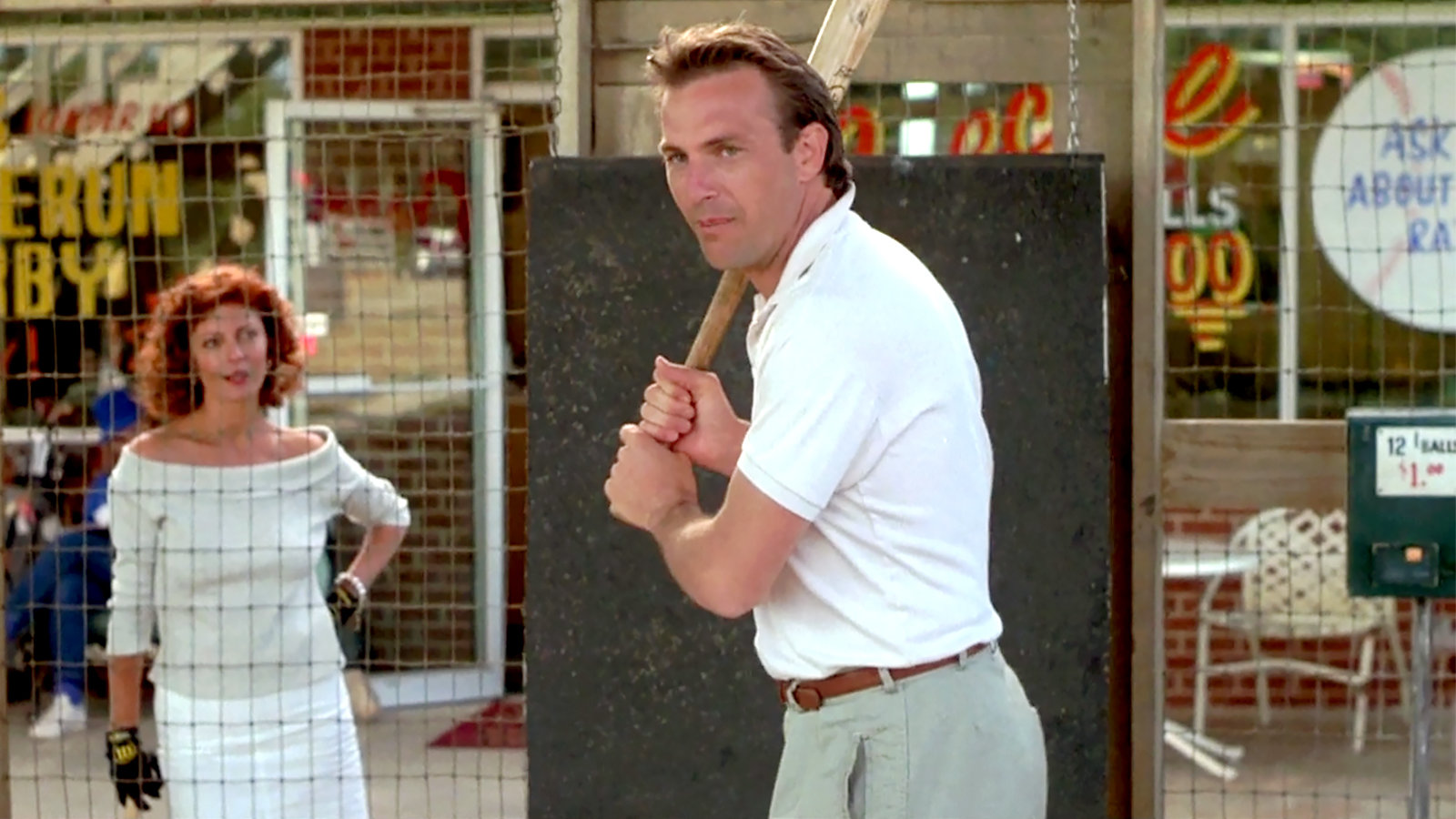
"Bull Durham" is not only the greatest baseball movie of all time, but might also be one of the greatest sports movies of all time. Despite my love for sports and movies, sports movies are often tedious to watch because they’re so predictable and formulaic. If you’ve seen one comeback story about the underdog like "Rocky," then you’ve watched 95% of sports movies. But then you get a film like "Bull Durham," which looks at baseball like it was a religion, a way of life, a fun life that can be as quick as a fast ball or as leisurely as a nine-inning game on a warm summer day. And not just in the way to watch baseball but how it encourages patience, focus and intensity into our everyday lives, but especially into the way we make love. It honestly believe that baseball has all the answers to life as Susan Sarandon molds young baseball players not just into fine men but fine lovers. It plays with its sport better than any other sports movie, creating this shrine to baseball as a mental state and why people love the game so much.

Writer and director Ron Shelton once described "Bull Durham" more as a western than a sports movie, and I can see why he would think that through Kevin Costner’s character. Costner plays an aging veteran baseball player who reluctantly comes to town to coach a rising star (Tim Robbins), who has a chance to make it to the majors if he can learn to stop being such a hothead. Robbins and Sarandon find Costner mysterious, full of wisdom and a love for the game but little love for himself. He’s rough and rash but wants nothing more than to make the game he loves so much a little bit better, even if that means he gets shafted for the majors. Just replace the wide-open plains of the old west with a baseball diamond and bullets with an equally fast baseball and you’ve got yourself the most unique and hilarious sports film you’ll ever see.


Final Grade: A

Movie Review - "Cat Ballou" (1965)


By the 1950s, the western genre was beginning to fade, slowly but surely taking those same western stories of exploring an unknown frontier and setting them in the truly unexplored frontier space, which would eventually create the sci-fi genre. By the 1960s though, the western was essentially dead in Hollywood (though not so much in Italy with Sergio Leone reinventing the genre). It had become a tired genre filled with cliches of cowboys roaming a land that had already been conquered, so Hollywood needed to do something new to keep the genre alive. And you can’t say that they didn’t try with "Cat Ballou," since it gave us one of the most memorable performances in a western with Lee Marvin’s drunk stumbling turned into an art form here.

"Cat Ballou" takes many of those tired Western cliches and turns them on its head a female lead (Jane Fonda), bandits who actually want to be helpful instead of selfish and greedy, a town that loves its criminals more than its heroes, a savior who actually can’t do anything unless he’s drunk as a skunk. It plays with some of these effectively enough, though the best part of the movie is certainly Lee Marvin who shows that he has the slapstick comedy timing of Charlie Chaplin and the intensity of John Wayne. It gets even better since Marvin plays two roles, the bumbling hired gun who becomes surprisingly articulate once he’s got some booze in him, and a quiet assassin with a piece of silver over his nose, with Marvin making each of them his own man. But beyond this, there isn’t much to "Cat Ballou." It has a few laughs, but despite trying to buck with the western cliches, it falls into many of the same trappings as before, only usually saved by Lee Marvin giving one of the best performances of his career.


Final Grade: C+

Tuesday, February 18, 2020

Movie Review - "Going My Way" (1944)


Fun fact: I grew up in the town where Bing Crosby lived, Spokane. One of our local theaters is named after him and every Christmas they play a marathon of a few of his movies, usually ending with "White Christmas." And yet I don’t think that theater, simply known as The Bing, plays the movies of his that I’ve seen lately, like the "Road to…" movies, or more recently the film that won Bing Crosby an Oscar, "Going My Way." You would think that film would have solidified itself as a Crosby classic but nowadays it’s not nearly as popular as "Holiday Inn" or "White Christmas." "Going My Way" is just as smaultzy and overly sweet as those films, so go figure.

"Going My Way" tells the tale of Father O’Malley (Crosby), a priest who is sent to a decaying church in New York to help the elder pastor (Barry Fitzgerald) and is to take charge of the affairs of the parish. The more traditional pastor and the more relaxed and unconventional priest don’t get along at first, but as Father O’Malley starts helping out around town by making the young delinquent boys into the church’s choir and a young woman thought to be a prostitute is given a new outlook on life by Crosby, the pastor starts to open up to him. It is easy to tell this film came out in the middle of World War II, showing that the battle back home is in good hands by men who put everyone else ahead of themselves and want nothing more than to make the world a better place, something Americans can aspire to be like and brings soldiers peace and comfort. Crosby is more relaxed and at peace in this role and the on-screen chemistry he has with Barry Fitzgerald is delightful, if a bit too sweet. Nowadays, "Going My Way" is harmless fun about a priest that genuinely wants to make the world better with an ending that you’ll either love or find contrived. It was good enough to win Best Picture in 1944, so I’d say it’s still worth a look.

Final Grade: B-

Movie Review - "Klaus" (2019)


"Klaus" is the closest we’ve gotten to classic Disney animated storytelling since "Hercules." The fact that it isn’t Disney makes that even more impressive. But it’s not because of the animation that looks hand-drawn yet is somehow more immersive than that, it’s not even because of the retelling of a fairy tale we’re all familiar with, in this case how Santa Claus came to be it’s because of its heart, the warmth and compassion it has for the wonder of Santa and a burning passion to share that warmth with everyone and shares its message loud and proud, that selfless kindness is as infectious as it is moving.

Everything we love about Santa is given a purpose here the reindeer, the cookies, the elves, his laugh, giving bad kids lumps of coal, all of it is given new meaning and often leads to hilarious results. What works especially well is that this Santa (voiced by J.K. Simmons) is paired up with a pampered but hopeless postman (Jason Schwartzman) who is forced to move to the island Santa lives on, a dark, snowy island where two rival families have constantly fought one another for generations. This postman reminds me of Kuzco from "The Emperor’s New Groove" egotistical and so sure of himself but is thrust into a world he was never ready for and has to make the best of it, leading him to build a strange friendship that becomes the backbone of the movie. And through this strange friendship that neither the postman or Santa fully understand, all of the Santa-isms are given new meaning, but especially the joy of giving back to the world and watching the happiness that springs from that.


"Klaus" is as lovely as it is imaginative and is just as entertaining for adults as it is for kids. The animation is beautifully colorful and atmospheric, the comedy wonderfully balances good slap stick with witty comebacks and jokes and every character is energetic lively, even the rival families in their seriousness about their on-going war. But I can’t overstate how loving and caring this film is, not just for the story of Santa Claus but for what he stands for, that no matter who you are and what you’ve done, everyone deserves that same joy we all feel when we get a new toy.

Final Grade: A

Friday, February 14, 2020

Movie Review - "The Gentlemen" (2019)


Guy Ritchie’s "The Gentlemen" is about a herd of alpha dogs competing to see whose ego reigns supreme. Everyone in the cast turns up the charisma to win both the approval of competing rival gangs and the audience. From Henry Golding’s suave but explosive Dry Eye, to Charlie Hunnam’s orderly but smug Raymond, to Hugh Grant’s slimey reporter who desires recognition for his storytelling abilities (he recounts everything like he’s writing a screenplay) to especially Matthew McConaughey’s resourceful thug who has gained more power than he had ever hoped and tries desperately to be, well, a gentleman. There is no shortage of likable and explosive characters in this gangster comedy, all of them acting like bloodthirsty lords who wish to be proper and regal.

Though at times, it does feel like these characters go off and wander away from the plot, like someone forgot to herd these alpha dogs. There are many times where the film wanders around aimlessly, like when McConaughey’s character is confronting Dry Eye’s boss or a subplot involving a rebellious teenage girl. It does give Hunnam a chance to be intimidating and McConaughey to show that he can be scary when he wants to be, but these scenes don’t really go anywhere. The biggest problem with "The Gentlemen" is that it’s all style and charm with little direction, letting that style overwhelm the story, especially when it comes to Hugh Grant’s description of the events like it was a glamorous movie that he’s weaving together. At times it is intriguing and even hilarious with the word play and clever insults, but the story never feels coherent and it often feels like there is no story its just gangsters being gangsters. It makes for an entertaining ride filled with odd ball characters that feel larger than life with a unique style of cutting things together like the movie was being made right in front of us, but without a solid story it lacks any real teeth fun but kinda forgettable.

Final Grade: B-


Saturday, February 8, 2020

Movie Review - "Dolemite" (1975)


“Dolemite” really is like if Ed Wood tried to make a Blaxploitation movie – a pimp, drug-dealing, comedian, kung-fu master tries to make a living in Hollywood despite the police and FBI constantly on his backs and an evil drug dealer trying to take his club and brothel, and there’s also a plot about arming a crazy priest for war in there too. The production values are non-existent, a lot of shots going on for about a minute longer than they need to, many pointless shots of kids playing in the parking lot or a long subplot involving a heroine addict, and a level of incompetent filmmaking that even a child could pick up on, like the boom mic in a lot of shots or the reflection of the camera man in every window (and there’s a lot of them). And then there’s our lead, Rudy Ray Moore, who fights everyone like he was Bruce Lee without ever actually landing a punch with the physique of someone who really loves his sweets. 

And yet, despite all of these flaws, there’s an undeniable charm to “Dolemite.” 

The film knows that it is not good and doesn’t care. What it does care about is making something for those wouldn’t normally be up on the big screen – the faces that aren’t instantly recognizable or the bodies that wouldn’t get a second glance. “Dolemite” is made by those people, for those people, giving they can look up to just like anyone else should be able to when they go to the movies. The inexperience behind the screen gives “Dolemite” an honesty that is both hilarious and oddly likable, like anyone learning a new craft with all of their bold visions of what they’d like to do. This film throws everything that it can at you – kung fu, gang violence, sex, comedy, car chases. It rarely sticks, but more than anything else with this movie, it’s all about the attempt.

Final Grade: C+

Thursday, February 6, 2020

Movie Review - "I Lost My Body" (2019)


"I Lost My Body" relishes in the bizarre, while also finding a strangely charming and unique idea in that same bizarre-ness. The film is about a young French boy, Naoufel, who recently had his hand severed in an accident. But rather than tell the story from Naoufel’s perspective, the film is told from his hand’s perspective, as it comes to life and desperately tries to make it back home to Naoufel without being spotted. The hand sometimes walks around like a flesh crab, while other times it looks like a little person, giving it a rather curious but hopeful personality that makes it rather lovable. Its journey is interspersed with flashbacks of Naoufel’s tragic life, but also how he always picks himself back up, making him just as likable as his hand, especially since both of them are so optimistic despite everything that’s happened to them.

But what makes "I Lost My Body" even more bizarre are the feelings that it evokes. Most films tend to focus on one of two senses, sight or sound. But "I Lost My Body" is the first film I’ve ever seen that plays on our sense of touch, evoking memories of how it feels to have sand running through your fingers, or holding your hand out of a car window and feeling the wind blowing through it, or even the sensation of trying to catch a fly. There are times where so many of these sensations start to feel tangible, like we’re right there with Naoufel. This is something no other film has tried to do and a point of view that is just as unique as it is charming, and it certainly makes "I Lost My Body" worth a watch.

Final Grade: A-

Friday, January 31, 2020

Movie Review - "1917" (2019)


While "1917" isn’t the first film to claim that it is all one shot (Hitchcock’s "Rope" comes to mind, as well as movies that actually are one take like "Russian Ark"), it is the most technologically impressive film to claim this feat. A film about a pair of young men charging head long into several battles of World War I to stop a massacre before it’s too late is difficult enough on its own, but every big moment in "1917" is done in one continuous shot, giving a larger sense of scale and grandeur, as well as building up the tension as we’re put in the middle of the action with these two, like we’re the third soldier going along for the ride. And while there are certainly moments where the film breaks and a new shot begins, the illusion and atmosphere is never broken as the film puts us right in the heart of such an inhuman struggle.

What sets "1917" above most other one shot films is all the risks it takes. There are so many impressive technological feats, like the long, disgusting walk through No-Mans’ Land as we go through several trenches, a field of barbed wire, passed several decaying bodies and across a body of water like we were gliding on top of it. Or a huge chase scene through a city reduced to rubble while flares light up the night sky. So many scenes that would be wonderful filmed normally, yet are made even more impressive by being one shot. The cinematography and production design is nothing short of a masterpiece here, breathing new life into this small story to make it seem so personal and thrilling.

Final Grade: A-

Wednesday, January 29, 2020

Movie Review - "Merry Christmas, Mr. Lawrence" (1983)


Merry Christmas, Mr. Lawrence" follows the lives of four men in a Japanese prisoner of war camp the Japanese commander (Ryuichi Sakamoto), his brutal sergeant (Takeshi), a British officer who lived in Japan (Tom Conti), and the rebellious British major (David Bowie) who tries to make life for the Japanese as difficult as possible. All four have had troubled pasts and try to make the best out of this bad situation, despite their drastically different backgrounds and cultures. Think "Bridge on the River Kwai" only more personable and tragic.

The driving force is the clashing of cultures, as the film perfectly balances the honor and humility of the Japanese with the freedom of expression, chivalry, and no-nonsense approach of the British. Conti tries to play the middleman and play both sides to show how they can get along, but also how much they can’t get along since even he loses his temper from time to time. Still, the biggest problem with this movie is its slow pacing, taking a lot of time with flashbacks to Bowie’s childhood and his grief. Bowie is a good enough actor that he could have explained it with one extended recollection rather than taking us out of the moment by cutting away from the conflict. And while it does play into the themes between the four characters of regret and shame, most of it comes across as unnecessarily slow.
 
Final Grade: C+

Monday, January 27, 2020

Movie Review - "Road to Utopia" (1946)


The “Road to…” movies are a rare breed of 1940s Hollywood cinema, desperately trying to get as much passed the censors as possible without ever breaking any codes. And while breaking the fourth wall has become more common over the years, you don’t see any movies made before 1960 doing it effectively…aside from the “Road to…” movies. They’re always a treat with Bing Crosby and Bob Hope dishing out one liners, ripping each other apart with insults, poking fun at their careers and Paramount, and desperately trying to win Dorothy Lamour over the other, like the two were bickering brothers trying to win the role of Deadpool. 

“Road to Utopia” gives you more of this and never lets up, trying to break the fourth wall more than any other movie. What separates “Utopia” from their other films, namely “Road to Morocco,” is that this film leans more on slap stick, with scenes involving Bob Hope sleeping with a bear or the pile of snow Hope sits on melting away as Lamour sings to him. “Morocco” balanced its slap stick and witty dialogue rather well, while “Utopia” has far more stunts and visual gags. At times, it has a lot more in common with Chaplin’s “The Gold Rush” than “Morocco,” though that could just be the similar setting and premise of two hopeless drifters trying to make it big in the Yukon during the gold rush. 

Still, “Road to Utopia” delivers on every front. The chemistry between Hope and Crosby is sizzling, the pacing gives the audience enough time to breathe between the jokes and more intense moments, and the comedy is even better than it was in “Morocco.” While the music isn’t as catchy, that’s not enough to distract from a fun time with one of the greatest comedic duos of all time. 

Final Grade: B+

Thursday, January 23, 2020

Movie Review - "Beneath the Planet of the Apes" (1970)


“Beneath the Planet of the Apes” is the most unnecessary bore I’ve ever seen. Not only does it repeat all of the same notes as the first “Planet of the Apes” for the first half of the movie, but does so without any sense of grandeur. Despite having a new man from our time, Brent (James Franciscus), discovering everything we already knew, he never looks any more interested than he would at the DMV, while never giving us any sense of a character or likability. It also certainly doesn’t help that he looks exactly like Charlton Heston, like the filmmakers wanted us to impose our feelings about Heston’s character onto Brent.

The film gets better in the second half, introducing the now-famous worshippers of an atomic bomb, but even then their behavior is wildly inconsistent and clashes with the ape storylines that it feels like it was taken from a different movie. And for what? An even bleaker and more depressing ending than the first film. At least that ending was shocking and put a new light on the entire movie. But this is just shocking for the sake of a shock. No reflection from the apes after getting undeniable evidence that there was an advanced civilization before them, no mutant trying to be anything more than cruel and manipulative or ever putting up a fight in the end, and no redemption for what’s left of humanity in the face of destruction. There is no message here other than humans are terrible, which shows how little thought was actually put into this movie.

Final Grade: D+

Monday, January 13, 2020

Movie Review - "Bombshell" (2019)

 
When it comes to addressing the pain and indecision of sexual harassment in the work place, “Bombshell” is effective and doesn’t pull any punches. It is smart about where this behavior comes from and the stigma it brings to those who have to bare it in front of their coworkers and put their careers on the line. Margot Robbie and Charlize Theron’s performances are wildly captivating for their vastly different portrayals, one baring her soul to the audience in all of its raw rage, while the other weighs that pain against her career and success and what all that truly means to her. 
 
However, beyond this hard-hitting talk of sexual harassment, “Bombshell” plays everything far too dramatically. The film opens up with how many of the scenes didn’t really happen and were added for “dramatic effect.” I can’t remember any film that outright says this and throws its authenticity out before the opening credits are finished. At no point did I feel this story deserved my attention. It felt like a TMZ report that made a big deal about a cheating celebrity – it’s certainly bad, but we’re probably making a lot of it up our heads. The only thing of merit in “Bombshell” are the performances of Robbie, Theron and Nicole Kidman, all three bringing their usual ferocity and charm to the picture and give the sexual harassment segments life. Other than that, this is a forgettable film told way too close to the news breaking to be balanced. 
 
Final Grade: C
 

Movie Review - "Little Women" (2019)


Whether you’ve never heard of Louisa May Alcott’s “Little Women” or you believe Hollywood has adapted this story more than any tale (Hi mom), there is an undeniable relevance in Greta Gerwig’s modern take on this story of four sisters trying to find their place in the world. Gerwig uses its post-Civil War setting to reflect on the state of the world from their perspectives – cold, brutal and dominating, especially for women. And through the performances of Saoirse Ronan, Florence Pugh, and Emma Watson, a love for life blossoms as well as a love to share that love with their siblings and others.

With Gerwig’s own take on the importance of identity guiding this movie though, it becomes surprisingly timeless and heartfelt. Rather than going all in on how women can be so much more than house makers and raising children, there’s a great love and pride for those that make this sacrifice. Gerwig not only romanticizes the past, but looks ahead to a bright future where anyone, not just feisty, artistic women, should look towards their own personal successes rather than what that dominating society might tell you. 

Final Grade: A-

Tuesday, December 31, 2019

Movie Review - "Texas Chainsaw Massacre" (1974)


Even in 2020, "The Texas Chainsaw Massacre" is hard to watch in the most gut-wrenching way a horror movie can be. Not every horror film can be as brutal or sickening as this time capsule about mutilation or its depraved look at insanity and the trauma it can create. Every moment I was either uncomfortable or wanted to turn off the movie, but only because of how thick the gruesomeness is and how it loves every second of violence and craziness. It often feels like the tapes a serial killer would make of what he did to his victims, and to do that in 1974 when the slasher genre hadn’t been created yet makes this one of the most important horror films of all time. It sets the standard for unsettling horror films to come and makes every horror film made before it look tame by comparison. It is difficult to watch because that’s how horror should be.

Final Grade: B


Movie Review - "Creature from the Black Lagoon" (1954)


It is fascinating to watch "Creature from the Black Lagoon" with the knowledge I have now, so many years after falling in love with movies like "Godzilla" and "The Shape of Water." Like many people, it is hard not to sympathize with the Gill Man as he defends his home from us, the invaders, and tries desperately to find love. He certainly is the most interesting character throughout the film, as every other character fills the generic monster movie tropes, including the macho hero (Richard Carlson), the greedy corporate leader (Richard Denning), and the helpless beautiful damesel in distress (Julie Adams), though it might help that the Gill Man has one of the best monster costumes ever made and is shown how dangerous he can be underwater with some rather beautiful underwater cinematography.

Though one thing I found distracting throughout the film was the music, since the same theme for the Gill Man would be used many times in "King Kong vs. Godzilla." Every time I heard his theme, I expected King Kong to show up and destroy a building. Still, I can see why "Creature from the Black Lagoon" has attained cult classic status - it is the right amount of campy monster goodness with seriousness, mixed with some great cinematography and an icon monster that may not really be a monster.

Final Grade: B
 

Movie Review - "Marriage Story" (2019)


"Marriage Story" is like an honest, heartfelt version of "Gone Girl," minus the kidnapping and murder - a tale of two emotional, vulnerable individuals that we see every possible side of, especially what's wrong with them, leading to an emotional roller coaster with many peaks and valleys that paints both parties in this marriage (Scarlett Johansson and Adam Driver) as neither good nor bad. There's a spell around this movie, the way it uses empathy and love during the moment most think love must end in a divorce.

It is through the many subtle gestures and silence of Driver and Johansson's performances that this film comes to life, as well as their unbridled love for their son. It is often heartbreaking and devestating, and yet it will put it all back together again through its comedy and honesty. If there is any film that perfectly encapsulates the difficult of love and its bottomless rewards, that film is "Marriage Story."

Final Grade: A