Thursday, July 2, 2015

Paul's Favorite Films - Number 15


Of all the films on this countdown, this is the movie that people have probably heard the least about.
The majority of these films are from America and Japan, with all but one of the Japanese films coming from critically acclaimed directors that most non-film buffs have heard of or are Godzilla films. This one is a relative unknown, but that is understandable.

When it comes to World War II, each country has its own interpretation of the events, as well as different feelings on the war. It makes talking about it quite personal, and difficult to discuss without looking it from your country's point of view. In America, we prospered after the war, even though the emotional toll was quite high. New and better technology was invented, the nation grew stronger and united, and we had seen the beginning of the baby boom era.

But what would about countries on the losing side of WWII? How did they fare after the war? Did their economy prosper or falter? How did they cope with the emotional toll? What did they do to survive losing a war?

Of all the films about World War II, Kinji Fukasaku's "Under The Flag Of The Rising Sun," leaves the biggest impact on me, because it takes a unique and stylized look at a side that is so often overlooked - the Japanese side of the war, and the aftermath it had on the Japanese people.

Fukasaku was known for directing films with an eccentric visual style, often using tilted camera angles and color filters, to give his movies a more dream-like state. Fukasaku had one of the longest careers in Japanese filmmaking, as he started in the early 1960s with small B-movies, moving up to direct many Japanese gangster (Yakuza) flicks, handled the Japanese segments of "Tora! Tora! Tora!" (a job that was initially given to legendary director Akira Kurosawa) and would end his career with one of the most outstanding films to come out of Japan, "Battle Royale" in 2001.

While "Battle Royale" is considered his masterpiece, "Under The Flag Of The Rising Sun" is more of a personal piece about the depths man will sink to during war, and how this has a continued effect long after the war has ended.

It has been 26 years since the end of World War II, and every year the Emperor of Japan visits the memorial to the nearly four million Japanese lives that perished during the war, but not all are accepted and appreciated. For example, the husband of Sakie Togashi (Sachiko Hidari) has been dead since 1945, but the cause of his death has been changed from killed in combat to execution, possibly because he mutinied against his superior officer. But because of the confusion at the end of the war, no one can be too sure of the legitimacy of those documents, meaning Sakie has wondered what killed her husband for 26 years and has never gotten an answer.

underflagsun

But thanks to a kind soul in the legal department, she is given the names of four surviving people in her husband's platoon that might be able to shed some light on what happened to him.

I like to think of this film as a combination of Stanley Kubrick's "Paths Of Glory" and Akira Kurosawa's "Rashomon." It has the same despicable and disgusting outlook on war as Kubrick's film, even down to officers executing their own kind for showing basic human traits and emotions in the heat of combat. That in war, we should remove our humanity and soul so that we can best serve our country, when that is impossible.

However, "Under The Flag Of The Rising Sun" has many more similarities to "Rashomon," as both films are about multiple eye witnesses recalling dire and drastic events, yet each person having completely different interpretations and coming to almost opposite endings, leading the audience to figure out which story is true and the others that must be false.

This gives "Under The Flag Of The Rising Sun" its own unique feel, as each story gives us a new perspective on the role that the war has played on the person. How their lives have been effected by it, and how they look back on these traumatic events. While there is room for doubt on each story, there is no hiding that Japan was crippled by WWII and is still hurt by it.

a%20Kinji%20Fukasaku%20Under%20the%20Flag%20of%20the%20Rising%20Sun%20DVD%20Review%20PDVD_012

Japan is a nation dedicated to honor and loyalty to Japan. But in war, honor may mean something on an personal level, but on a grand scale honor and loyalty means nothing. According to this film, the Japanese soldiers believed the superiority of their country and way of life and that would lead them to victory. But as this war continued on, it was clear that it took more than dedication and honor to survive, let alone win.

During the battles that took place on New Guinea, the Japanese had roughly 12 working cannons, all of which were useless pieces of junk. It had gotten to the point where only 45 machine guns remained among the 800 troops, and the rest were forced to make spears out of bamboo against the heavily armed Americans and Australians.

And those were the soldiers that could actually stand up and fight, not counting the thousands of Japanese troops that died on the boats, were lost to the ocean, were never seen again while traveling through the mountains, or had died (or were dying) of starvation or malnutrition. Those rocky mountains had nothing eatable other than a few potatoes that were stolen from local villagers, which the soldiers would naturally fight over.

UnderTheFlagOfRisingSun%20(26)

One point is made clear in this film - In that kind of environment, where supplies are gone, the enemy is beating down on you and you must fight to get even a scrap of food, how can one be honorable and loyal? Is sacrificing yourself to starvation proper to save Japan?

War brings out the disgusting parts of humanity, where "honor" means nothing.

We are given many war stories in "Under The Flag Of The Rising Sun," each more disturbing than the last, but all with a common theme throughout all - the need to survive, and the sacrifices that must be made. Each story has Sakie's husband as the main character, as he steals potatoes from his fellow troops, kills his friends to have something to eat, and plans the murder of his crazy superior officer who has gone mad with power.

Very little of this film is about the Japanese troops fighting the enemy, but rather themselves. Each survivor speaks of very little about what it was like to be in the heat of battle, and instead obsesses about what they were fighting for and that Japan would emerge as the strongest nation. But only to realize that Japan has since turned their backs on their soldiers, even forcing one survivor into a theater comic routine where he is a long forgotten soldier who thinks the war never ended.

undertheflag

This is still a big problem in Japan - the lack of respect for the older generation. Very often, the newer generation seems ungrateful to those who sacrificed their lives so that Japan could continue on. This now massive metropolis and economic power that risen up from two atomic bombs and bureaucratic collapse, insists on looking forward, never backwards. Another survivor is now a school teacher, and often wonders why he sacrificed his youth and innocence when these children don't care about that.

There are many terrifying images in "Under The Flag Of The Rising Sun," most of which are real photographs from the war of destruction and mutilated bodies. This makes the film one of the most brutally honest and unflinching depictions of WWII that I've seen, and certainly falls into its own class by being about a side of the war that isn't often looked at. With hauntingly beautiful cinematography that gives this a nightmare quality, "Under The Flag Of The Rising Sun" a terrifying portrayal of war that deserves much more attention.

220px-Fukasaku_Under_the_Flag_R1_DVD

Tuesday, June 30, 2015

Mini-Review - "Hannah And Her Sisters" (1986)

MV5BMjIwMTk0Njc4Nl5BMl5BanBnXkFtZTcwODc5MjkzNA@@__V1_SX640_SY720_

This Woody Allen film is like a "Seinfeld" episode, if they removed all the character and comedy. Just a lot of pointless chatting that amounts to basically nothing.

"Hannah And Her Sisters" is one of the prime examples of why I often cannot stand Woody Allen's work. His films feel like they're always working up to that last joke, where everything comes together and gives the audience one big laugh. But the problem with that is Allen seems to forget that we have to wait for an hour and a half to hear that punch line, all while we have to listen to his annoying ramblings about his fears of having a brain tumor or how he needs proof that God exists and that he doesn't see a point in living if there isn't anything definitive.

There were points in this film where I found myself saying "Shut up" to Woody Allen being a nihilist hypochondriac. There is nothing redeeming or enjoyable about a character who won't stop talking about how much life sucks or complaining about how his life is terrible.

I think the point where I started to not care about "Hannah And Her Sisters" was a scene where Holly (Dianne Wiest) and April (Carrie Fisher) go around New York City with this guy they just met. After touring some buildings in New York, the group then spends at least two minutes arguing about which should be taken home first, as they work out the details of traffic, miles and city streets.

They spend what feels like an eternity discussing traveling through New York City.

I understand that "Hannah And Her Sisters" is supposed to be more of a piece on life and have it move at a normal pace, while the characters talk like normal people. But that's boring. That is merely our reality, when film is supposed to be reality taken to its most extravagant extremes. What is the point of a film where nothing interesting happens?

This isn't a film, it is a family slide show extended to an hour a half.

I can see why others would enjoy "Hannah And Her Sisters," but I am not one of them. This film is annoying, unfunny and not gripping at all. It reinforces my stance that Woody Allen can be a tedious filmmaker - He has his share of gems, but you have to be really patient while you get through his irritating work.

Final Grade: D

Saturday, June 27, 2015

Paul's Favorite Films - Number 16


Everyone has that one movie they watched more than any other when they were a kid. That film that kids never got tired of, and could watch on repeat with the biggest smiles on their faces. The movie that fills them with endless joy, bringing them back to some their happiest moments of childhood.

My best friend admits that film for him is Jean-Claude Van Damme's "Bloodsport," while my sisters will happily say Disney's "The Fox And The Hound," which we never owned a physical copy of and just choose to keep renting from Blockbuster, even though buying it probably would have saved us some money.

For me, I can honestly say that the film I watched the most as a child was Nicholas Meyer's "Star Trek II: The Wrath Of Khan." I watched this classic science fiction tale of the Star Trek crew more than any single Godzilla film, Disney animated picture or television shows on Nickelodeon. At a young age, I was entranced by the space battles that felt like two titans dueling it out, while ending in a struggle to out run a bomb that threatened to kill every one of these beloved characters, giving us one of the saddest moments for any child to watch.

But as I've grown older, I've revisited this film while attempting to remove the nostalgia goggles and see if it holds up. Each time I watch "Star Trek II: The Wrath Of Khan" now, I have grown to love it even more as it tells a literary-worthy tale of aging, revenge, loss, acceptance and mortality without ever trying too hard.

ST2_1

Set a few years after the events of "Star Trek: The Motion Picture," James T. Kirk (William Shatner) has been promoted from Captain to Admiral and now sits behind a desk, while he watches young cadets who "don't know how to steer (the spaceship)" hop around the galaxy. Meanwhile, the crew of the USS Reliant searches for a barren planet to test a controversial device on and accidentally discovers Khan (Ricardo Montalban), who was stranded on this rock in space by James Kirk fifteen years ago and never bothered to check up on him. Khan, a genetically engineered super solider, uses his intellect to take command of the Reliant and begins his plan for revenge against Kirk.

Harve Bennett, the producer and story writer for "Star Trek II: The Wrath Of Khan," had never watched a single episode of "Star Trek" before making this film. So, unlike J.J. Abrams, Bennett decided to watch every episode of the original series to understand what would make a good "Star Trek" movie. He ultimately decided to tell a Shakespearian space opera that would begin with a simple image - An aging Kirk, on his birthday, surrounded by cadets just coming out of training.

Kirk admits early in the film that gallivanting around the universe was a job for the young. That he no longer fits that mold and he should try to find a new place for himself in the universe, much to the dismay of his friends, Dr. McCoy (DeForrest Kelley) and Spock (Leonard Nimoy). He is reminded that commanding the Enterprise was what he was good at and he loved more than anything else. But he knows that, in his old age, he is more likely to make mistakes and endanger his crew.

What Kirk didn't count on was that the mistakes he made in his youth would come back to bite him, especially Khan.

Khan is the best singular villain in the Star Trek universe, because he is the antithesis of Kirk. Where Kirk is brash, innovative and charismatic, Khan is cold, calculating and would not hesitate to snap your neck. This is amplified when you realize just how much Khan despises Kirk, the man who left him and his entire crew to die on a lifeless planet.

the_wrath_of_khan

One of the most important shots in the film is a glimpse of Khan's bookshelf, where we see books such as "King Lear," "Paradise Lost," "Dante's Inferno" and "Moby Dick." With how much time Khan had on his hands, there's no doubt he read those novels endlessly while he watched his crew slowly fade away and used those as the inspiration to mount his revenge on Kirk. Afterall, he was prince on Earth at one point, much like Satan was in "Paradise Lost," who had fallen to the lowest depths, shunned from the rest of the world.

Now that Khan has a ship and the means to mercilessly pursue Admiral Kirk, he has become Captain Ahab. And he must obsessively hunt down the white whale that wronged him. No matter the cost, no matter what gets in his way, Khan will stop at nothing to see Kirk burn.

"I've done far worse than kill you," says Khan to Kirk. "I've hurt you. And I wish to go on hurting you."

star-trek-2-the-wrath-of-khan

Another point that Harve Bennett realized about the original series of "Star Trek" was how Kirk always cheated death, or escaped death by the skin of his teeth "and patted himself on the back for his ingenuity" but had never faced death before. This is shown in the Kobiyashi Maru test that all Starfleet trainees must take, which is a no-win scenario that is more of a test of character to see how everyone reacts to an impossible situation, where death is inevitable.

Because how we deal with death is just as important as how we deal with life.

But we learn that Kirk took the Kobiyashi Maru test three times, and beat the simulation by reprogramming it. In other words, he cheated. Because Kirk doesn't like to lose.

Yet, when Khan arrives, Kirk must lose. He must finally face death and the vengeance of the man that he wronged. The mortality that he has so carelessly tossed around is now facing him with a weapon that could destroy an entire planet.

star-trek-wrath-of-khan

All of this reaches its boiling point in the scene that is now famously parodied, due to Shatner's delivery of his frustration with Khan, as he screams at the top of his lungs with his eyes nearly popping out of his skull. But in the sequence that follows, Kirk reflects on the life that he could have had if he settled down with Carol Marcus and their son David, instead of one with Khan hunting him down and a young crew that is dying thanks to him. Shatner speaks barely above a whisper, and is able to speak louder than his screams as he realizes that he is old and worn-out.

I bring all of this up to show that, even without the action sequences that I loved as kid, "Star Trek II: The Wrath Of Khan" is able to tell an elaborate and well-thoughtout story that reflects the characters from the television show, while also making them more human in the process. People often remember this film for the submarine-like duel climax in the nebula and the heart-breaking ending, but now I find myself being enthralled in the conversations between Kirk and Saavik (Kirstie Alley) as much as the space battles that flow organically from the plot.

Overall, "Star Trek II: The Wrath Of Khan" is one of the glowing examples of my evolution through cinema. As a kid, I loved this film for its action, effects and suspense. But, as I grew up, I began to see there was so much more that it had to offer. From the Shakespeare-like story, to the catchy score by James Horner. This shows that some films get better with age, while others get better while you age.

khan-poster

Friday, June 26, 2015

Mini-Review - "Soylent Green" (1973)

Soylent_green

The unfortunately sad truth about "Soylent Green" is that most people only remember the film for its twist ending, though said ending has been ranked as one of the best twists in all of cinema. But it is too bad because "Soylent Green" does have a bit to offer outside of that twist.

In particular "Soylent Green" has a sickening atmosphere that matches the all too realistic future setting. Ask most scientists what is the biggest problem that humanity must face in the future, and every answer you'll get will come back to the same instigator - overpopulation. The world was not made to support seven billion human and growing, and as a result our resources will slowly being to dwindle, our environment will fade away to support the incoming supply of humans and poverty will set in for most societies.

"Soylent Green" takes the problem of overpopulation to its ultimate conclusion - 40 million people living in New York City, most animals are extinct including the animals we use for food, 30 million people are without a job, and even the people that do have income and a place to live have never seen vegetables, meat, books or a hot shower. There is a sick green mist throughout most outdoor scenes, as if the air is polluted, giving the film a feeling that everyone is sick and dying, including the planet.

It paints a drastic picture of a future where survival is everything, even if it means stealing from others who are more fortunate. The main character, Frank Thorn (Charlton Heston), has a decent job as a detective, but takes every opportunity he can get to steal from the rich so that he and his friend, Sol Roth (Edward G. Robinson, in his last role), can enjoy the small things that remind them the earth was once plentiful and beautiful.

For this reason, the twist ending seems almost logical from a business stand point. The Soylent company is fighting to save the human race from extinction, and is using the resources that they have left to do so. It just so happens that those resources are unethical and immoral.

"Soylent Green" is one of the few science fiction films that depicts a future that seems so real that it is frightening. From the crowded hallways of apartment complexes to the inability to move through the city without taking an hour to go one block, there is this fear that we are not too far off from that if we continue to populate without considering the ramifications.

Final Grade: B

Thursday, June 25, 2015

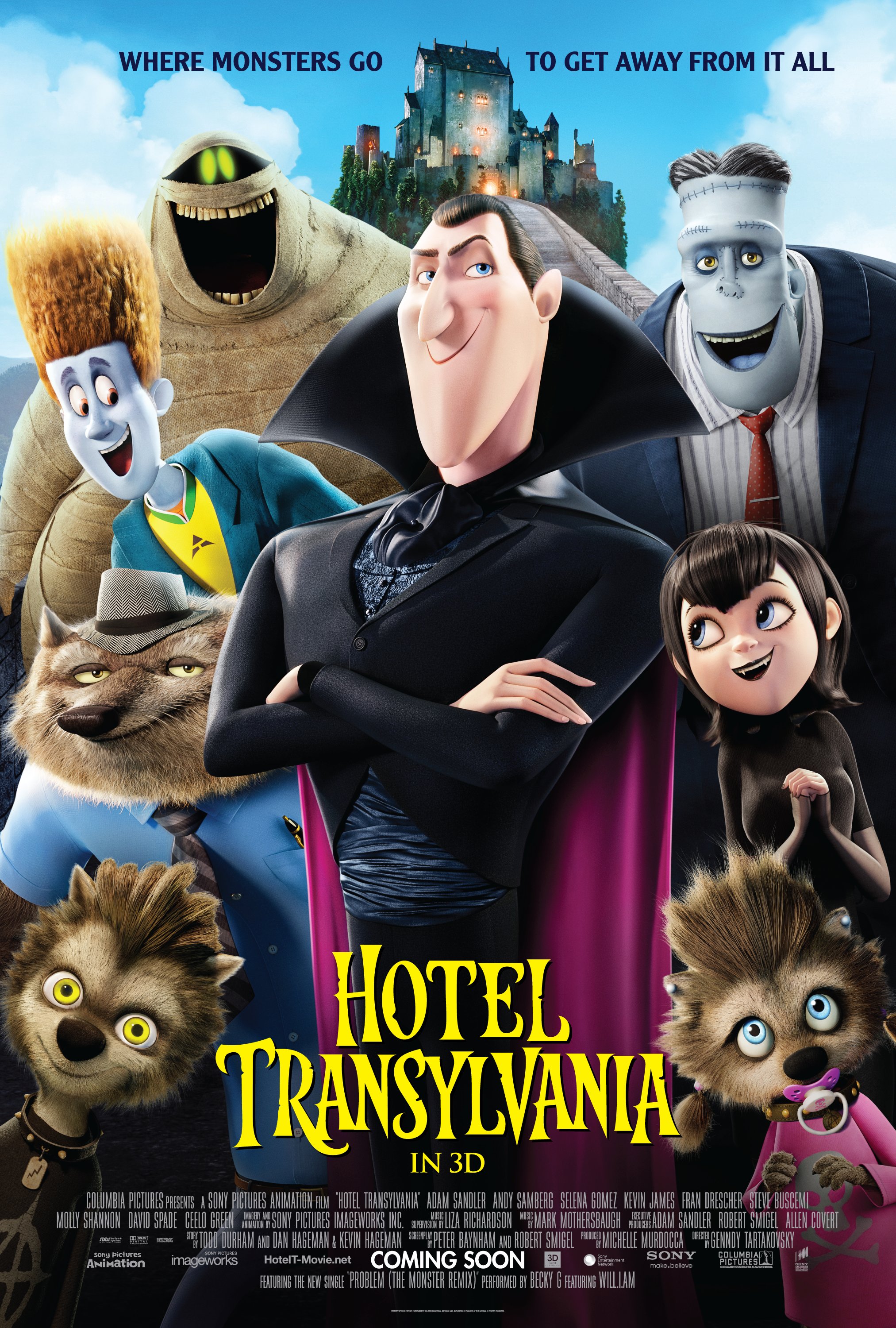
Mini-Review - "Hotel Transylvania" (2012)

hotel-transylvania-poster

This movie has taught me one important lesson - Adam Sandler can be funny in a movie, when he has zero creative control over the film.

Sandler has not been funny in cinema since "Happy Gilmore," as each subsequent film from him and his production company, Happy Madison, seems to get worse by being more pandering than the last.

To put it simply, Happy Madison and Adam Sandler have turned into the Michael Bay of movie comedy, by appealing to the lowest common denominator and having an onslaught of insulting race or gender humor, or just sticking with fart and poop jokes.

But then I remember how talented and hilarious Sandler was on Saturday Night Live and in films like "Punch Drunk Love," where his only job was to entertain the audience, and had no input behind the camera. The same can be said for "Hotel Transylvania," a film that should have failed on paper.

Here is the cast of voices for this animated Halloween flick: Adam Sandler as Dracula, Kevin James as Frankenstein, David Spade as the Invisible Man, CeeLo Green as the Mummy, Selena Gomez as Dracula's daughter and Steve Buschemi as the Wolf Man. What could turn this around? How about the director, Genndy Tartakovsky, the man behind "Dexter's Laboratory," "Samurai Jack," many episodes of "The Powerpuff Girls," and co-creator of the "Star Wars: Clone Wars" mini-series.

Tartakovsky has always taken advantage of the animated genre, in particular the speed and movement, especially how unnatural it can be. Which fits perfectly for a hotel full of monsters, ghouls and abominations. "Hotel Transylvania" works because of the insanely fast pace of the comedy that never seems to stop. Every second the film is throwing new visual jokes at you, like bumping into a range of monsters in the hotel lobby as it sets off a chain of events that send magic spells and parts of Frankenstein everywhere.

The voice acting, though sporadic due to CeeLo Green and Selena Gomez, hits the nail on the head, with Sandler surprisingly being the standout performance. Not once did it feel like it was Adam Sandler doing a funny voice, but Count Dracula being an overprotective father that truly cared for all monsters. Sandler disappears in this role, which is a first for him.

"Hotel Transylvania" was a fun ride, with a great visual sense of humor and a creative animated premise. Though there are some scenes that feel out-of-place, especially near the end and the odd musical choices throughout, there is a genuine love for monsters and their legacies. The film takes full advantage of its setting and characters and takes ever opportunity to throw something new at us.

Final Grade: B+

Monday, June 22, 2015

Paul's Favorite Films - Number 17


I freely admit it - I don't care for musicals. At all.

There are a multitude of reasons for this, but it usually comes back to my lack of knowledge and understanding of music. It's not that I think music is bad, but that I do not care for most of it. Musicals often fall into the same category, as they end up relying more on the musical numbers in the film and not telling a good story.

In fact, most musicals I've seen are just excuses to sell their catchy tunes. That the story bits and character interactions between are just small bridges to get to the next number.

However, perhaps I have watched the wrong musicals. Because if they made more movies like Gene Kelly and Stanley Donen's "Singin' In The Rain," I would not have a problem watching as many musicals as I can get my hands on. While I may not enjoy most musicals, I make a gigantic exception for "Singin' In The Rain," because there is not a single moment in this film that does not make me smile or laugh. From the lavish and colorful musical numbers, to the chemistry between our three main leads, to the abundance of zany and off-the-wall comedy. To say there is never a dull moment in this film would be an understatement.

It is the late 1920s in Hollywood, and things could not be looking better for dynamic romantic silent duo of Don Lockwood (Gene Kelley) and Lina Lamont (Jean Hagen), even though Don can't stand her and Lina saw in one of her fan magazines that Don was going to propose, so it must be true. But after the release of their recent film, the head of the studio reveals something that everyone laughs and scoffs at - talking pictures. He also announces that Warner Bros. will be making an entire film with it, "The Jazz Singer."

One of the guests calls it a novelty and says it will never take off. Don's best friend, Cosmo Brown (Donald O'Connor) points out that people said the same thing about the horseless carriage.
As time goes on, people crave more talkies, so the studio head is forced to make Lockwood's next film, "The Dueling Cavalier" into a movie with sound, much to the dismay of the film crew that is told to "do the same thing, except now they talk."

Singin_In_Rain_1951

As demonstrated with "Ed Wood," I adore movies about the filmmaking process, and "Singin' In The Rain" covers possibly the best and most damaging era of Hollywood - The end of the silent era and the beginning of talkies. Most filmmakers didn't know it then, but the invention of sound changed the way that films would be created. Before that, everybody had to act with their eyes and expressions, despite the lack of connection with the audience. Now that sound began to trickle into people's ears, that barrier between film fiction and reality seemed a bit thinner.

"Singin' In The Rain" chooses to take a more romanticized look at this era, with optimism and hope towards the future. That this is better for filmmaking and will end up giving audiences pictures that they can enjoy and want more of. One point that is stressed early on is that many of Lockwood's silent pictures move, act and feel the same. That if you had seen one, you'd seen them all. But Lockwood uses this to his advantage when sound comes around and puts all of his talents to use.

Which leads me to what I love the most about "Singin' In The Rain," Gene Kelley. There are many superb talents out there that can claim they are the triple threat, able to act, sing and dance. If this film is any indication, Gene Kelly blows all of those actors out of the water. In acting, he is charismatic, full of joy and wishes to spread that happiness to everyone around him. When singing, his voice glides through the air, smooth but carrying weight behind it, as if it could cut through fog. But Kelly is at his best when dancing, as he puts everything he has into his movements and tap shoes. At some point, I was afraid that his shoes would catch on fire from how elaborate and lightning fast his feet moved.

singin-in-the-rain1

Gene Kelly put his entire body into this performance, as if every action he made was to awaken Sleeping Beauty so that she could live her happily ever after.

Many sequences in "Singin' In The Rain" are done in long, uncut takes, which adds to the technique and skill needed to pull of Kelly's dance numbers. Several shots last more than a minute of Kelly dancing in a rainstorm or jumping off couches.

Speaking of uncut sequences, "Singin' In The Rain" has one of my favorite scenes of all time. Though the titular scene of Gene Kelly sharing his love of the world in the rain is still masterfully executed, the best scene has to be Donald O'Connor's extended musical number, "Make 'em Laugh."


Adding O'Connor to the film was a much needed breath of relief and gives the film its best comedy. His "Make 'em Laugh" sequence is many extended takes of visual slap stick, which includes getting hit in the head with a big piece of wood, slamming into a brick wall, doing several running kung-fu-like jumps off set pieces, and spinning in a circle on the ground while laughing hysterically. And all while singing about how he is in show business to entertain people, and that the best way to do that is through laughter.

Even when "Singin' In The Rain" isn't enthralling us with elaborate musical numbers, the comedy never ceases to give me a good belly laugh. For example, Lina Lamont is happily absorbed in her own little show-biz world, where Don loves her (he would rather kiss a tarantula), she has power over how her pictures turn out (the director can't even keep the record on pace with the film) and everyone loves her in everything she does, including talkies.

It is too bad that she has the voice of Minnie Mouse on helium combine with cat claws on a chalkboard. Even after going through speech treatment, she can't pronounce the simplest line without sounding like the windows will shatter at any moment.

Poor Jean Hagen. That voice had to be murder on her throat, because she was murdering her own movie when she talked.

Here is an impressive tid-bit about "Singin' In The Rain" - Aside from one song, every musical number in the film was taken from a different MGM musical from the past, including the title song. All of these now famous pieces of music were not created for this film, but were merely incorporated to create one coherent musical.

maxresdefault6

The only number that was made for "Singin' In The Rain"? "Moses Supposes," the song that Gene Kelly and Donald O'Connor sing during speech treatment.

This adds another level of appreciate to "Singin' In The Rain." Sometimes it is more difficult to take an existing song and find a way to work it into the movie than it is to make a new song that can be custom-made for the film. It makes "Singin' In The Rain" not only appreciate the 1920s, but also the many musicals that created these catchy tunes.

"Singin' In The Rain" is the only musical I can say that I truly adore. The film exudes cheer and enthusiasm for cinema. The musical numbers are lively and brightly-colored, the comedy never ceases with Donald O'Connor and Jean Hagen, the story of 1920s Hollywood is portrayed in an optimistic and heart-warming way, and Gene Kelly is something that everyone needs to see to believe. This is one that never fails to be fun and joyous.

Saturday, June 20, 2015

Movie Review - "Inside Out" (2015) - Emotions, Memories and Pixar

MV5BOTgxMDQwMDk0OF5BMl5BanBnXkFtZTgwNjU5OTg2NDE@__V1_SX214_AL_

Has Pixar ever disappointed us? Have they ever run out of ideas that are imaginative, thought-provoking and entertaining? Because I'm hard-pressed to think of anything that Pixar has done wrong.

Even Pixar at its worst, particularly "Cars" and "Cars 2," still found a way to keep itself fresh and innovative, even with the main character being voiced by Larry The Cable Guy. In those films, there was a sense of child-like innocent that felt like you were playing with toy cars and coming up with these crazy stories about why they're racing. These might have just been gimmicks to sell toys, but at least they had good morals.

And that is Pixar on their off days.

In my opinion, Pixar can do no wrong. They have given us some of the most beautifully animated films of the last two decades, that are always smart, caring, funny, moving, innovative and colorful, all without an air of smugness or superiority. Pixar's films are at their best when they appeal to your child-like whimsy and wonder of the world, but also treat you like an intelligent adult without spoon-feeding you everything.

While Pixar has been relatively quiet the last few years, mostly producing sequels, their most recent work, "Inside Out," finds them returning to their roots and giving us a story that appeals to everyone, while still giving us the charm of films like "Up" and "Toy Story."

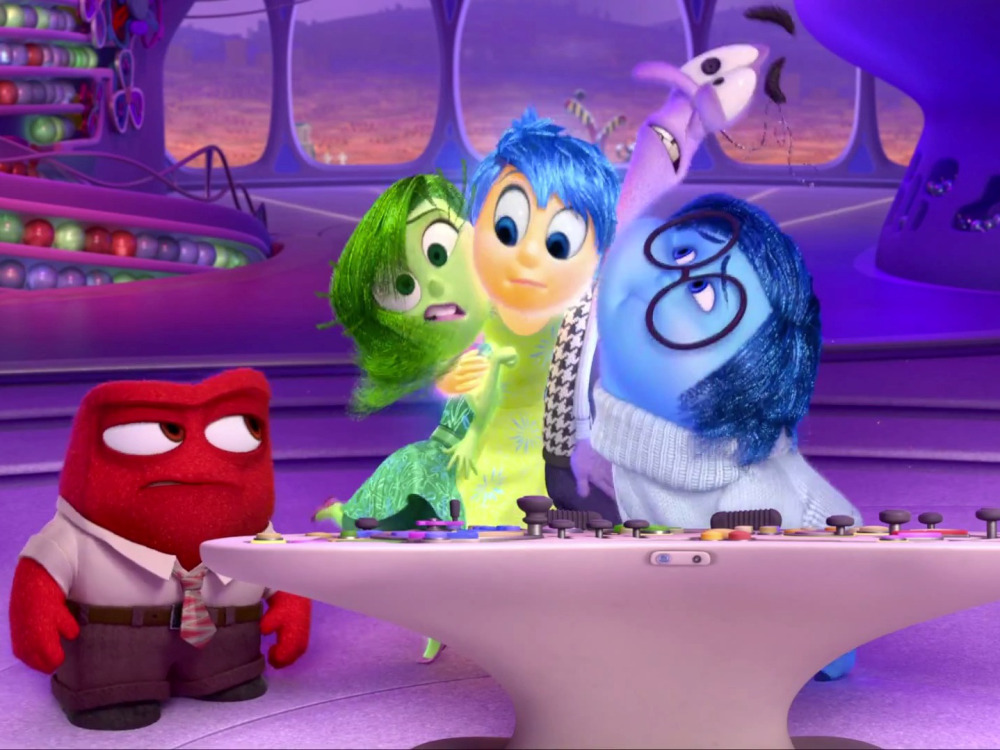
The story of "Inside Out" follows the childhood of a girl named Riley, but from the perspective of the emotions in control of her mind, Joy (Amy Poehler), Anger (Lewis Black), Fear (Bill Hader), Disgust (Mindy Kaling) and Sadness (Phyills Smith). The five of them work together to make sure that Riley leads a good life, even if all of them have differing ideas of how Riley's life should be operated.

pixar-inside-out-movie

Imagine this as "Boyhood" but from inside the head of the boy. And then animated by Pixar.

What I love about "Inside Out" is that these feel like the proper emotions that only wish to make Riley happy. Joy is blissfully ignorant but is always an optimist and very proud of how Riley has turned out, while Fear is afraid of Riley stepping on a crack in the sidewalk yet keeps everything in line to make sure that she doesn't do anything reckless.

The conflict arises because the emotions are still new to all of this and do not want to work with the others. All of them are hotheaded (especially Anger) because all they see in the world is their emotions. Why should Disgust have to cooperate with other emotions when there is nothing but gross and rude things in the world?
 
Screen grab of youtube video 'Inside Out US Teaser Trailer' Web to Watch - Inside Out Catch a sneak peek at what’s next for Pixar. The animation studio posted a teaser trailer for the summer 2015 movie Inside Out starring Amy Poehler, Bill Hader, Lewis Black and Mindy Kaling. The movie focuses on the personified emotions (e.g. disgust, fear, anger, sadness) inside the head of a young girl. youtube.com/DisneyPixar

All of this would explain why children are so emotional, because they don't fully understand their own emotions. It isn't until they all can work together that children grow up.
 
Throughout "Inside Out," we get glimpses of the thoughts and conflicts inside of other characters heads, particularly Riley's parents. Or rather, the lack of conflict. At the dinner table, the family talks about their day, but Riley's emotions fight for control. While her father's team work as a group to handle the situation, almost in a military style. Her mother, however, have all five act nurturing and supportive, with each adding perspective to what the mother would say.

This isn't just the conflict in one little girl's head, but in all of us.

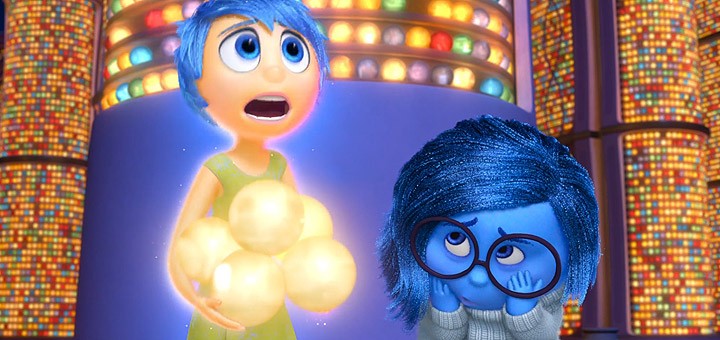
Everyone finds themselves wrestling with their own emotions, to the point where it seems like they are in control. Who we are and what we do is dictated by our own feelings and how use those emotions. This moves "Inside Out" out of the realm of fantasy and makes it a relatable story about understanding ones feelings and not letting one emotion control you. That the best experiences in life come when let the full range of emotions out, even the negative ones.

inside-out-720x340

Outside of that, "Inside Out" has the usual Pixar charm of taking outlandish scenarios and putting as much imagination and thought as possible into it. We see every part of Riley's brain, and how her memories, dreams, subconscious and core thoughts run. Never does this feel tedious or repetitive, as each new part makes the human brain sound fascinating. From the movie-like production of her dreams, to her subconscious acting as a jail to her deepest fears.

The human brain is this constantly busy community that works like a well-oiled machine, fuelled by memories and purpose.

"Inside Out" is the best Pixar film since "Up" and easily ranks among their best work. This is by far their most imaginative film, setting an entire film inside the head of a girl, yet still able to make this epic chase around her never-ending maze of memories and save her defining characteristics. With a great sense of humor thanks to Bill Hader and Lewis Black, a vibrant color scheme that compliments the ongoing conflict, and a poignant message about emotions that anyone can understand, "Inside Out" surely will not be forgotten any time soon.

Final Grade: A-