Saturday, September 17, 2016

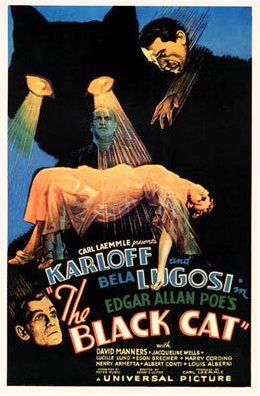
Movie Review - "The Black Cat" (1934)

black_cat_poster

Wow, I would have never guessed - Bela Lugosi and Boris Karloff are the same height. Either Dracula is taller than I thought he was, or Frankenstein is shorter than I gave him credit for.

The height of these two massive horror stars does come into play at one point their first meeting, 1934's "The Black Cat," with Lugosi playing a Hungarian psychologist who has recently been released from a massive prison after 15 years, supposedly put there by Karloff, an eccentric Austrian architect who has build his futuristic mansion on a former battlefield. Lugosi blames Karloff for his imprisonment and for the death of his wife and daughter, with Karloff keeping the wife encased in a glass shrine, so that everyone may see her beauty for all eternity.

In other words, Lugosi is psychically seeking revenge, while Karloff is obsessed with collecting people and death.

blackcat-1934

For a film coming off the heels of "Dracula" and "Frankenstein," it is strange to see these two in roles that doesn't involve anything supernatural. To see these icons play people, crazed as they may be, instead of other-worldly monsters and abominations. Which is why their same height is so striking - it makes you realize they are playing humans who are equally matched, instead of monsters that tower over us.

However, I will say that "The Black Cat" takes a while to get moving. There's a plot involving a couple on their honeymoon, whom Lugosi saves and takes to Karloff's castle for rest, but we learn little about these two, outside of the husband being a famous writer of mysteries. They move the plot forward and give Lugosi's character something to fight for, but all they do distract from some of the better scenes involving the two lead actors.

Overall, "The Black Cat" has some great scenes between Bela Lugosi and Boris Karloff, the first time these two shared the screen together, and does a wonderful job showing how both men are despicable creatures who enjoy the sight of others in pain. But with too much focus on other uninteresting characters, this one does leave me cold, wishing there had been a tighter focus on the lead actors, or at least better written minor characters.

Final Grade: B-

Thursday, September 15, 2016

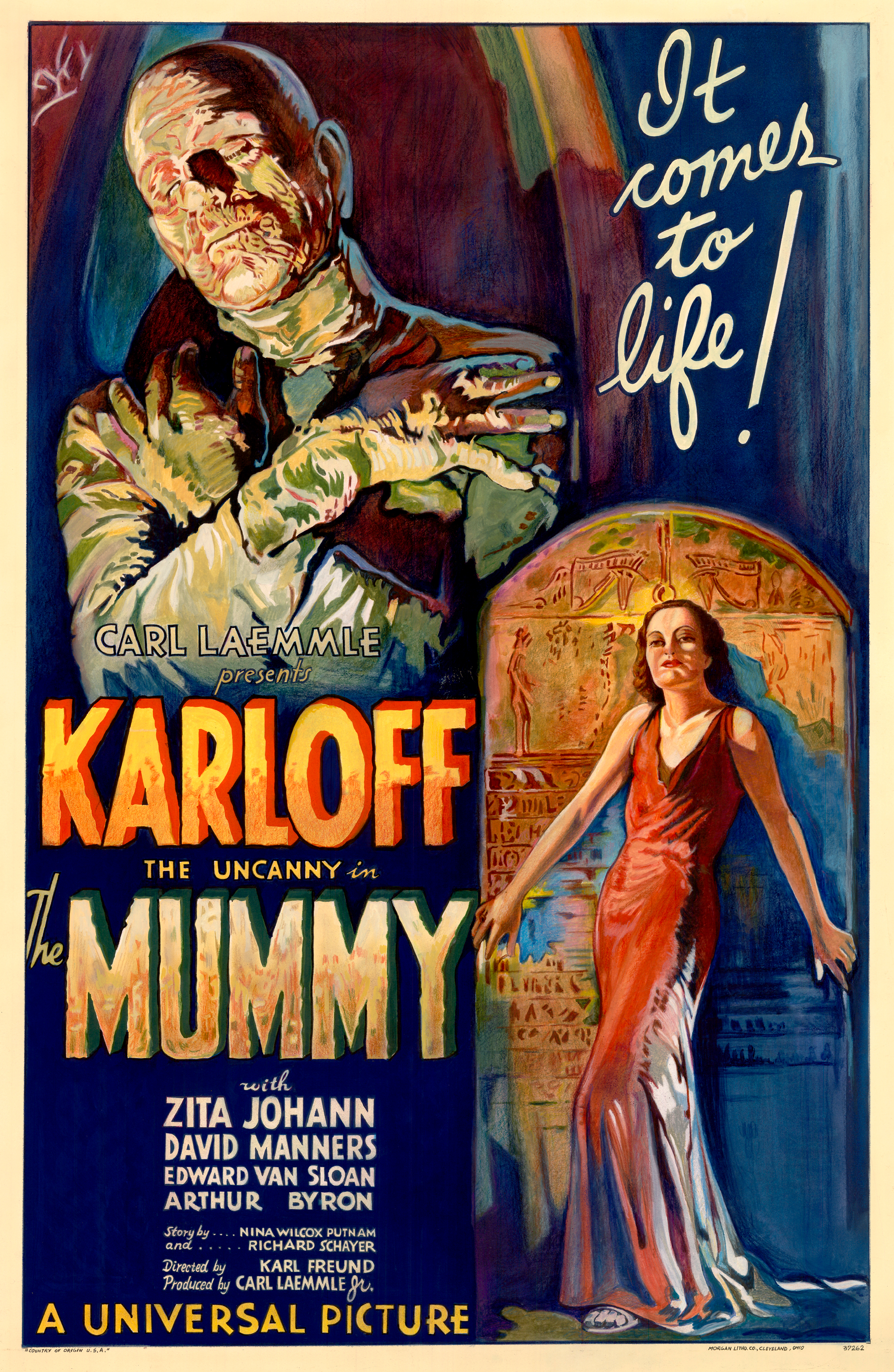
Movie Review - "The Mummy" (1932)

the_mummy_1932_film_poster

This has quickly become my favorite of the early Universal horror films, even ahead of "Dracula" and "Frankenstein." While those horror movies rely on high-concept monsters that have since become larger than life, "The Mummy" relies heavily on mood and atmosphere, where the empty darkness is just as much of a player as the titular mummy.

If you've seen the 1999 remake of "The Mummy" starring Brendan Fraser, then you know the basic premise - archeologists uncover an ancient tomb and disturb the slumber of a 3,700-year old mummy, who is now set on bringing is one true love back to life as well and silence anyone who gets in his way. While the remake is more action-oriented, the 1932 film focuses on the unnerving performance by horror-icon Boris Karloff, who gets far more screen time than he did in "Frankenstein," and gets to speak, always about his undying love for his Ankh-es-en-Amon.

While Karloff offers subdued control throughout the film, always using the archeologists to get what he needs and using his ancient magic to kill those who stand in his way, the lack of a score throughout most of the film and the dark lighting play just as big of a part. There is a general feeling of emptiness in "The Mummy," like the sands of Egypt, that provoke a sense of unease and mystery. Like you might be swallowed by the shifting sands at any moment. This is something other early Universal horror films lack, the atmosphere that nature is just as much of an enemy as the monster.

Overall, "The Mummy" not only sets the standards to every following supernatural archeological movie, but shows that silence and a creepy Karloff performance can be as terrifying as everything else. While it is a shorter film, around 75 minutes, every frame is oozing with atmosphere.

Final Grade: A

Tuesday, September 13, 2016

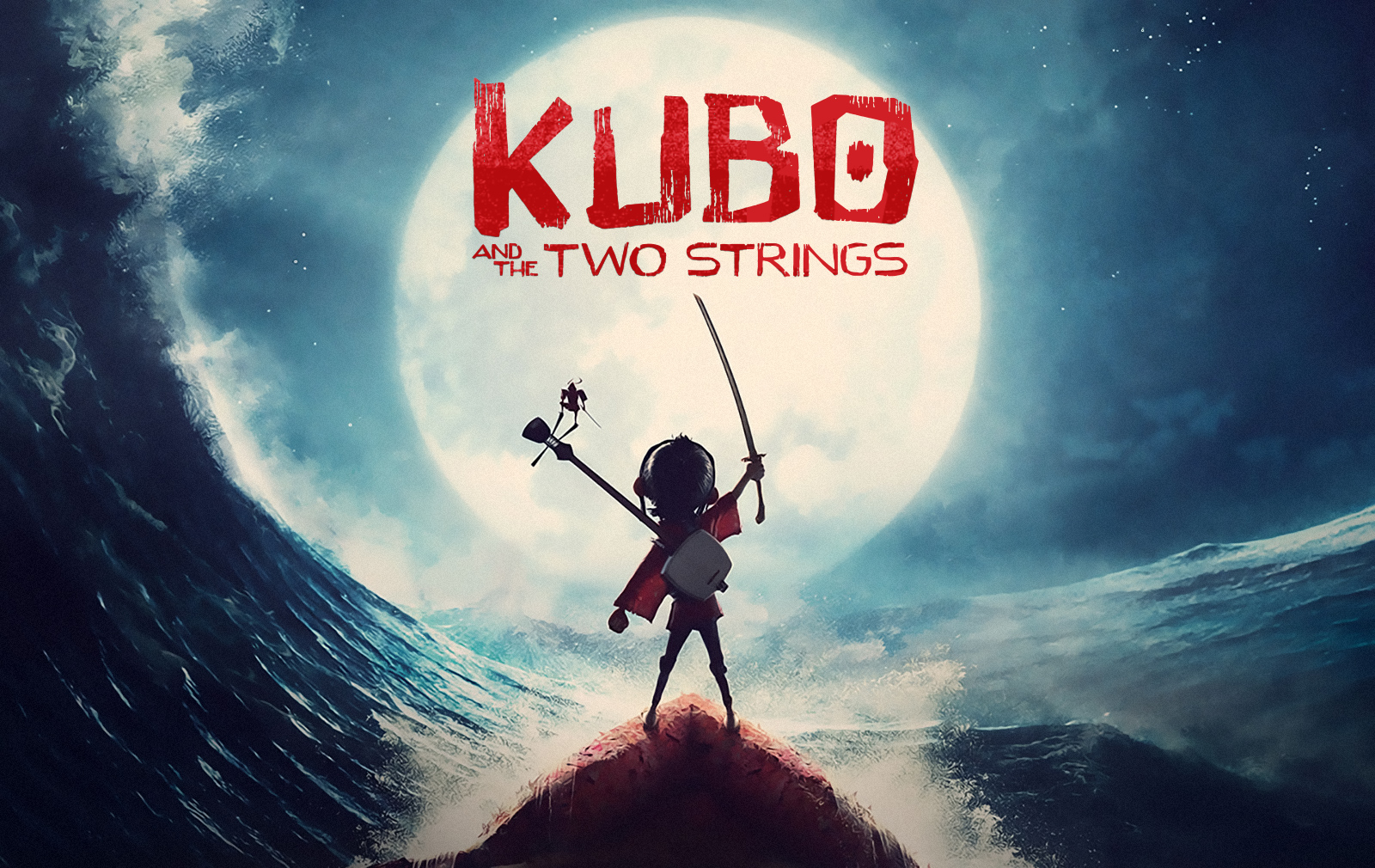
Movie Review - "Kubo and the Two Strings" (2016)

kubo-main_0

As I sat down to watch "Kubo and the Two Strings," I noticed a child sitting near me with his father. He couldn't have been older than six. He was squirming in his chair, making lots of noise about wanting his Icee. I could make out glances of the father constantly smiling, even though his kid wasn't interested in the movie. Perhaps the father wanted to see the movie more than his kid, or he was just thrilled to share a moment with his child. Or, maybe he knew what was coming.

Because after a certain point in "Kubo and the Two Strings," when the villains make their first appearance, and the bright and colorful Japanese world turns to night and we see these two shadowy figures drapped in long cloaks wearing masks with an eternal smile that cover their entire faces, this film takes a drastic and severely dark turn.

After that scene, I never heard a peep out of the kid. I would occasionally glance over to see if he was still there and not asleep - his eyes were transfixed on the screen, sometimes filled with awe, other times with terror.

kubotwostrings

Some people have compared "Kubo and the Two Strings" to Japanese mythology, as well as films from Disney and Pixar, especially darker ones. But after watching this little boy go through so many startling emotions, I think "Kubo" has more in common with Don Bluth films from the 1980s, like "The Secret of NIHM" and "The Land Before Time." These films hid behind the cloak of being called "children's animation" by showing colorful and cute cartoons, only to throw our heroes into horrifying situations that would scar any child for life.

And yet, those who stuck around couldn't get enough of those films. While Disney animated films keep a child distracted, usually putting it on in the background while kids play with toys, Don Bluth's best work demanded attention. Those films were haunting, but that's what made them so memorable.

"Kubo and the Two Strings" works like this, as you get invested in the dark mystery of this world, learning how the mythmaking works and the fantastic powers at play.

As our hero, Kubo (Art Parkinson), is born his grandfather steals one of his eyes. His parents take Kubo away from his castle and flee, his father dying in the process. Kubo's mother takes him to a hidden village, where his mother lies motionless during the day and is lively and loving as soon as the moon comes out. During the day, Kubo goes into the village and uses his magical powers to make origami come to life, which he uses to tell fantastic stories of the samurai Hanzo fighting the dreaded Moon King, though he is never able to come up with an ending to his story.

But one night, Kubo finds out why he shouldn't stay out once the sun sets, and learns that his story about Hanzo is not a fantasy. With the help of a talking monkey (Charlize Theron) and a cursed samurai-bug (Matthew McConaughey), Kubo now sets out on a journey to collect the mythical pieces of Hanzo's armor and fight the Moon King, his grandfather.

This is the best looking film Laika productions has created since "Coraline," with a distinct focus on origami and use of paper. At one point, Kubo creates a ship out of leaves and they use it to sail across this expansive ocean. There's something about this flimsy orange boat traveling across a vast sea with hardly a ripple to be seen, the water being a perfect mirror to the setting sun.

kubotwo

These beautiful moments are contrasted nicely with the horrors that await them at every turn. Like a massive red skeleton with samurai swords sticking out of its head, or an ocean filled with enormous yellow eyes that fill you with misery, making you relive your worst memories until you drown of sadness.

This is what I mean by "Kubo" being similar to Don Bluth's films - This world is filled with wonders that too mysterious to fully comprehend, but also ones that are too terrifying. It is both surreal and whimsical at the same time. It can be hard to watch, but you can't look away from it either.

secretofnihm

"Kubo and the Two Strings" works a modern "The Secret of NIMH," with some added mythology and fantasy for good measure. This one is beautifully animated, using both stop-motion animation and CGI, filled with a colorful cast of characters and a fascinating back story for Kubo. But the film doesn't shy away from dark and disturbing moments and show that this world can be as harsh and cruel as it is wonderous and awesome. For that reason, it is one of the best children's' films I've seen in a while.

Final Grade: A-

Friday, September 9, 2016

Movie Review - "Broken Arrow" (1950)

broken_arrow_film_poster

"Broken Arrow" is a respectable and compassionate western when you consider the time it came out. In 1950, the villain of every western was either a lone evil cowboy or, more likely, Native Americans. "Stagecoach" started this trend, because Native Americans seemed like the natural rival to roaming cowboys of the west, who would fight for their territory. Thus, it was often shown that Native Americans were the bad guys who had to be stopped.

But then "Broken Arrow" came along to us that the Native American man was no different from any other man, and could be just as reasonable and understanding. The film follows prospector Tom Jeffords (James Stewart) as he attempts to befriend rival Native American leader Cochise (Jeff Chandler), who has been able to round-up nearly every tribe across the continent together to help their struggle and take back their land. Jeffords is convinced that he can reason with Cochise and at least get him to allow mail-carriers through their territory.

"Broken Arrow" does its best to show the struggle to maintaining peace between the Native Americans and the people of Tuscon, both of whom want to stop the continuous war and bloodshed, but are afraid of change and what the other side might be preparing for. There is this nagging lack of trust, but Jeffords and Cochise are convinced this will fade over time.

But the reason "Broken Arrow" stands out is because of what it did that no other western before 1950 did - have so much respect for the Native American community. In this film, these tribes are coordinated and calculating when they need to be, but also filled with compassion. They understand that they world around them is changed, and they must adapt to survive - whether that means fighting for survival, or lowering their weapons and offering a hand in friendship.

For this, I applaud "Broken Arrow" for destroying the cliché of the evil Native Americans in westerns and making these tribes relatable.

Final Grade: B-

Thursday, September 8, 2016

Movie Review - "Mr. & Mrs. Smith" (1941)

smith_moviep

This is the first time I've had an opportunity to talk about a dead film genre - The screwball comedy.

A screwball comedy can be traced back as far as Frank Capra's "It Happened One Night" and hit its popularity in the mid-1930s and early 1940s, especially when director Preston Sturges made "The Lady Eve" and "The Palm Beach Story." A screwball comedy is usually about an unlikely romance that forms between two drastically different yet equally awkward and strange characters, and plays heavily on the slapstick and physical side of the relationship. You won't see screwball comedies today, since they've been replaced with romantic comedies.

It's strange to have grown up in an age where romantic comedies are so prevalent, to the point they're almost a cliché, and then go back and watch films like "Bringing Up Baby" and "The Philadelphia Story" to see how that genre has evolved over the years. The difference between a screwball comedy and a romantic comedy is noticeable, and yet difficult to describe. In a film like "When Harry Met Sally..." you can tell this is about the romance that is slowly forming between two characters, but in "It Happened One Night," the romance sneaks up on you. These two characters go on a journey together, and slowly realize they want to be with the other.

"Mr. & Mrs. Smith" is a screwball comedy that came out in the middle of that craze, but picked the wrong director for the job - Alfred Hitchcock.

In a film about a couple that has been unhappily married for a few years finding out their marriage has been nullified and can now do all the single things they've wanted to do, Hitchcock is not the proper director for this story. There is no sense of thrill or suspense throughout this film, and almost everything is played for laughs. It comes across like Hitchcock wanted to be like Preston Sturges and tell a witty yet heartwarming story, but gave up halfway through and gave in to the slapstick.

As a screwball comedy, "Mr. & Mrs. Smith" is a fine distraction that has some good chemistry between lead actors Robert Montgomery and Carole Lombard, with a touching, if a bit rushed, climax in the mountains as the two realize how they feel about one another. But as a Hitchcock film, this one doesn't hold up at all, with no discernible marks or traits you would expect out of the director.

Final Grade: C

Wednesday, September 7, 2016

Movie Review - "Lady In The Lake" (1947)

lady-in-the-lake

Imagine "Hardcore Henry" without any shakey-cam or nauseating fight sequences, and you'll get the idea for "Lady In The Lake."

The film follows private detective Phillip Marlowe, having been portrayed by many actors including Humphrey Bogart, Elliott Gould and Robert Mitchum but now being played by Robert Montgomery, as he decides to stop being a private dic., supposedly because it doesn't pay well, and becomes a mystery novel writer, starting with one of his own cases. But as Marlowe turns his story into his publisher (Audrey Totter), she asks him to take on a case that would pay handsomely, involving the missing wife of his publisher's boss. Marlowe takes the case, and quickly finds out that murder and betrayal is involved here.

What separates "Lady In The Lake" from other mysteries and noir at the time is the entire film is shot from Marlowe's first-person perspective. What the detective sees, the audience sees as well. This means that every character is talking directly into the camera and we see little of Montgomery, only briefly catching a glimpse of him in the mirror or his shadow if the lighting is right.

This idea can work, but after watching this film and "Hardcore Henry," I have become convinced that it is a novelty that wears thin quickly. We never feel any connection to Marlowe because we can't see how he's reacting to everything. He finds a note addressed to the missing wife at the publisher's house and we have no idea if he's confused, angry, upset or a bit of everything.

Granted, the movie is more about letting the audience solve the case along with Marlowe, but the first-person perspective gets old rather quickly when everyone keeps talking into the camera and we hear the disembodied voice of Marlowe yell at every suspect. Still, I do appreciate that "Lady In The Lake" is basically saying the fourth wall doesn't exist here, especially when Marlowe introduces the film by telling us we are the stars.

Overall, while the mystery of "Lady In The Lake" is solid, the camera-work and perspective of the film gets old after the first act. Montgomery tries to be the smooth-talker as well as having the brevity of Phillip Marlowe, but something seems off about his performance, especially since Bogart and Gould captured the role so brilliantly. Nothing all that special here, just a gimmick that over stays its welcome.

Final Grade: C

Monday, September 5, 2016

Movie Review - "Logan's Run" (1976)

Logans_run_movie_poster

A cult classic from 1976, it is not hard to see why "Logan's Run" has left its mark in the science-fiction genre. Set in the year 2274, human society now lives in a futuristic domed city after the nuclear holocaust, where all humans are born artificially with gems in their hands so the computers can keep track of their lives. This city is filled with parties and clubs and no elders in sight, since human lives are now meant to be terminated after reaching the age of 30. Daily events called Carousel are performed and celebrated, where the "elders" are renewed in a strange, almost psychedelic, manner. But there are always those who don't want to be sacrificed and become runners to be hunted down by the police, including Logan 5 (Michael York).

What makes science-fiction such a fascinating genre is that you can tell stories that you could never dream of in other genres. "Logan's Run" presents us with a society where no one is over the age of 30 and how different the world would be, where life is a continuous party and thrill ride until you willingly give up your life for the greater good. Society is run by computer and we don't have to make any decisions for ourselves, except for the choice to stay or run for your life.

"Logan's Run" reminds me of "Soylent Green" if it embraced the fully acid-trip style of the 1970s. This film screams of the love and peace era, when youths were questioning their place in the world, expressing their feelings through protests and drugs, while also rejecting the society that came before them for "a better world."

In fact, "Logan's Run" has a bit in common with other post-apocalyptic movies of the time, including "Planet Of The Apes." The third act of "Logan's Run" follows our hero as he tracks down runners who supposedly made it out of the domed city to a place called Sanctuary. As he makes it out of the dome, we find out this place is right outside of Washington D.C. Logan finds himself in a world utterly foreign to him, but all too familiar to the audience. While Logan doesn't learn how the world go to be this way, he does joyously learn that humans can live long past 30 and wishes to share that knowledge with everyone.

Overall, "Logan's Run" is deserving of cult status, with some unique ideas on how society would work if it were run by children and young-adults. The effects are sometimes impressive, especially when overlooking the sprawling domed city, and other times not so great, like the explosion effects. The film slows down once Logan makes it out of the city, a drastic change to the fast pace while inside the dome. Not a great science fiction film, but certainly one worth looking at.

Final Grade: B-