Friday, September 9, 2016

Movie Review - "Broken Arrow" (1950)

broken_arrow_film_poster

"Broken Arrow" is a respectable and compassionate western when you consider the time it came out. In 1950, the villain of every western was either a lone evil cowboy or, more likely, Native Americans. "Stagecoach" started this trend, because Native Americans seemed like the natural rival to roaming cowboys of the west, who would fight for their territory. Thus, it was often shown that Native Americans were the bad guys who had to be stopped.

But then "Broken Arrow" came along to us that the Native American man was no different from any other man, and could be just as reasonable and understanding. The film follows prospector Tom Jeffords (James Stewart) as he attempts to befriend rival Native American leader Cochise (Jeff Chandler), who has been able to round-up nearly every tribe across the continent together to help their struggle and take back their land. Jeffords is convinced that he can reason with Cochise and at least get him to allow mail-carriers through their territory.

"Broken Arrow" does its best to show the struggle to maintaining peace between the Native Americans and the people of Tuscon, both of whom want to stop the continuous war and bloodshed, but are afraid of change and what the other side might be preparing for. There is this nagging lack of trust, but Jeffords and Cochise are convinced this will fade over time.

But the reason "Broken Arrow" stands out is because of what it did that no other western before 1950 did - have so much respect for the Native American community. In this film, these tribes are coordinated and calculating when they need to be, but also filled with compassion. They understand that they world around them is changed, and they must adapt to survive - whether that means fighting for survival, or lowering their weapons and offering a hand in friendship.

For this, I applaud "Broken Arrow" for destroying the cliché of the evil Native Americans in westerns and making these tribes relatable.

Final Grade: B-

Thursday, September 8, 2016

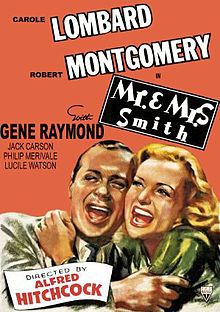
Movie Review - "Mr. & Mrs. Smith" (1941)

smith_moviep

This is the first time I've had an opportunity to talk about a dead film genre - The screwball comedy.

A screwball comedy can be traced back as far as Frank Capra's "It Happened One Night" and hit its popularity in the mid-1930s and early 1940s, especially when director Preston Sturges made "The Lady Eve" and "The Palm Beach Story." A screwball comedy is usually about an unlikely romance that forms between two drastically different yet equally awkward and strange characters, and plays heavily on the slapstick and physical side of the relationship. You won't see screwball comedies today, since they've been replaced with romantic comedies.

It's strange to have grown up in an age where romantic comedies are so prevalent, to the point they're almost a cliché, and then go back and watch films like "Bringing Up Baby" and "The Philadelphia Story" to see how that genre has evolved over the years. The difference between a screwball comedy and a romantic comedy is noticeable, and yet difficult to describe. In a film like "When Harry Met Sally..." you can tell this is about the romance that is slowly forming between two characters, but in "It Happened One Night," the romance sneaks up on you. These two characters go on a journey together, and slowly realize they want to be with the other.

"Mr. & Mrs. Smith" is a screwball comedy that came out in the middle of that craze, but picked the wrong director for the job - Alfred Hitchcock.

In a film about a couple that has been unhappily married for a few years finding out their marriage has been nullified and can now do all the single things they've wanted to do, Hitchcock is not the proper director for this story. There is no sense of thrill or suspense throughout this film, and almost everything is played for laughs. It comes across like Hitchcock wanted to be like Preston Sturges and tell a witty yet heartwarming story, but gave up halfway through and gave in to the slapstick.

As a screwball comedy, "Mr. & Mrs. Smith" is a fine distraction that has some good chemistry between lead actors Robert Montgomery and Carole Lombard, with a touching, if a bit rushed, climax in the mountains as the two realize how they feel about one another. But as a Hitchcock film, this one doesn't hold up at all, with no discernible marks or traits you would expect out of the director.

Final Grade: C

Wednesday, September 7, 2016

Movie Review - "Lady In The Lake" (1947)

lady-in-the-lake

Imagine "Hardcore Henry" without any shakey-cam or nauseating fight sequences, and you'll get the idea for "Lady In The Lake."

The film follows private detective Phillip Marlowe, having been portrayed by many actors including Humphrey Bogart, Elliott Gould and Robert Mitchum but now being played by Robert Montgomery, as he decides to stop being a private dic., supposedly because it doesn't pay well, and becomes a mystery novel writer, starting with one of his own cases. But as Marlowe turns his story into his publisher (Audrey Totter), she asks him to take on a case that would pay handsomely, involving the missing wife of his publisher's boss. Marlowe takes the case, and quickly finds out that murder and betrayal is involved here.

What separates "Lady In The Lake" from other mysteries and noir at the time is the entire film is shot from Marlowe's first-person perspective. What the detective sees, the audience sees as well. This means that every character is talking directly into the camera and we see little of Montgomery, only briefly catching a glimpse of him in the mirror or his shadow if the lighting is right.

This idea can work, but after watching this film and "Hardcore Henry," I have become convinced that it is a novelty that wears thin quickly. We never feel any connection to Marlowe because we can't see how he's reacting to everything. He finds a note addressed to the missing wife at the publisher's house and we have no idea if he's confused, angry, upset or a bit of everything.

Granted, the movie is more about letting the audience solve the case along with Marlowe, but the first-person perspective gets old rather quickly when everyone keeps talking into the camera and we hear the disembodied voice of Marlowe yell at every suspect. Still, I do appreciate that "Lady In The Lake" is basically saying the fourth wall doesn't exist here, especially when Marlowe introduces the film by telling us we are the stars.

Overall, while the mystery of "Lady In The Lake" is solid, the camera-work and perspective of the film gets old after the first act. Montgomery tries to be the smooth-talker as well as having the brevity of Phillip Marlowe, but something seems off about his performance, especially since Bogart and Gould captured the role so brilliantly. Nothing all that special here, just a gimmick that over stays its welcome.

Final Grade: C

Monday, September 5, 2016

Movie Review - "Logan's Run" (1976)

Logans_run_movie_poster

A cult classic from 1976, it is not hard to see why "Logan's Run" has left its mark in the science-fiction genre. Set in the year 2274, human society now lives in a futuristic domed city after the nuclear holocaust, where all humans are born artificially with gems in their hands so the computers can keep track of their lives. This city is filled with parties and clubs and no elders in sight, since human lives are now meant to be terminated after reaching the age of 30. Daily events called Carousel are performed and celebrated, where the "elders" are renewed in a strange, almost psychedelic, manner. But there are always those who don't want to be sacrificed and become runners to be hunted down by the police, including Logan 5 (Michael York).

What makes science-fiction such a fascinating genre is that you can tell stories that you could never dream of in other genres. "Logan's Run" presents us with a society where no one is over the age of 30 and how different the world would be, where life is a continuous party and thrill ride until you willingly give up your life for the greater good. Society is run by computer and we don't have to make any decisions for ourselves, except for the choice to stay or run for your life.

"Logan's Run" reminds me of "Soylent Green" if it embraced the fully acid-trip style of the 1970s. This film screams of the love and peace era, when youths were questioning their place in the world, expressing their feelings through protests and drugs, while also rejecting the society that came before them for "a better world."

In fact, "Logan's Run" has a bit in common with other post-apocalyptic movies of the time, including "Planet Of The Apes." The third act of "Logan's Run" follows our hero as he tracks down runners who supposedly made it out of the domed city to a place called Sanctuary. As he makes it out of the dome, we find out this place is right outside of Washington D.C. Logan finds himself in a world utterly foreign to him, but all too familiar to the audience. While Logan doesn't learn how the world go to be this way, he does joyously learn that humans can live long past 30 and wishes to share that knowledge with everyone.

Overall, "Logan's Run" is deserving of cult status, with some unique ideas on how society would work if it were run by children and young-adults. The effects are sometimes impressive, especially when overlooking the sprawling domed city, and other times not so great, like the explosion effects. The film slows down once Logan makes it out of the city, a drastic change to the fast pace while inside the dome. Not a great science fiction film, but certainly one worth looking at.

Final Grade: B-

Friday, August 19, 2016

Movie Review - "The Magnificent Seven" (1960)

magnificent-seven-poster

This was a difficult watch, just like I know this is going to be a difficult review, because "The Magnificent Seven" is so incredibly close to "Seven Samurai" that it sometimes comes across as if the American version is ripping off the Japanese film, when I shouldn't be comparing the two and look at "The Magnificent Seven" on its own merits.

In a way, I'm glad I have watched "Seven Samurai" four or five times in my life before watching "The Magnificent Seven" for the first time. If I had only watched Kurosawa's samurai masterpiece once or twice, most of the similarities and respectful tributes would go over my head. If I had never seen "Seven Samurai" before this, the comparisons would be lost on me. But now I know almost every major plot point in "Seven Samurai" and can point to every key scene for its significance and how each scene is like a beautiful sand-swept painting by Kurosawa, without ever getting tiresome.

The story of "The Magnificent Seven" follows a small Mexican town being constantly attacked and pillaged by Calvera (Eli Wallach) and his bandits. The townspeople decide they will not stand for this crimes anymore and that they must protect themselves by hiring bodyguards. As some of the townsfolk head across the border to a nearby town, they come across Chris Adams (Yul Brynner), who is more than willing to protect the village. Chris eventually gets assistance from six other cowboys, including Vin Tanner (Steve McQueen), Britt (James Coburn) and Bernando O'Reilly (Charles Bronson).

While the comparisons to "Seven Samurai" are unavoidable, I think that's what "The Magnificent Seven" was going for. Keep in mind this came out in 1960, when you couldn't see "Seven Samurai" unless you had an indie or foreign movie theater or lived in Japan. But American film studios loved "Seven Samurai" and wanted to share its story of a gang of misfits protecting a village for no reward with the rest of the world, and found this was the best way to share that experience.

There are many scenes in "The Magnificent Seven" that are direct copies from "Seven Samurai," including the introduction of Charles Bronson and James Coburn's characters, while also giving us a slightly different interpretation of Yul Brynner's introduction, while still laying the ground work of how calm and calculating his character is, much like Takashi Shimura's leader.

Strangely enough, the runtime for "The Magnificent Seven" is about half the length of "Seven Samurai," yet it still feels like every major scene in the Japanese film is covered here, including the rouge and hot-blooded character giving his grand speech about how cowboys/samurai's make peasants want to take up weapons just to defend themselves.

But the biggest improvement "The Magnificent Seven" has is its villains. "Seven Samurai"'s bandits got the job done, but they were the most basic and undefined villains you can think of - they steal, kill and burn down villages, that's about it. But now we get a grandiose performance from Eli Wallach, who played Tuco in "The Good, The Bad and the Ugly," who loves to drone on about how much he loves his lifestyle and believes he is being grateful to the villagers. He is so full of himself that you love seeing his grin that shows off is silver tooth, and you want to see these cowboys gun him down for being the biggest bastard around.

Overall, "The Magnificent Seven" is a wonderful homage to an even better movie. I keep going back and forth on whether I should compare this movie to "Seven Samurai" or let it stand on its own, but I think as both an adaptation and a captivating western. It brings a foreign product to American audiences in a way we can understand it, while still giving us the best parts of "Seven Samurai." Yet the film still stands on its own, powered by many great performances from Steve McQueen, James Coburn and Eli Wallach.

Final Grade: A-

Thursday, August 18, 2016

Movie Review - "3:10 To Yuma" (1957)

310-to-yuma-poster

There's a strange sense of claustrophobia in the open air throughout this black-and-white western, "3:10 To Yuma," as Ben Wade (Glenn Ford) has to transport a well-known criminal and killer, Dan Evans (Van Heflin) from his small town to the train station, while being pursued by Dan's gang. All the while, Dan tries to persuade Ben to join his side and let him go free for a large sum of money, and eventually resorting to threats against Ben's wife and how badly Ben treats her.

The cinematography is what sells "3:10 To Yuma," through its crisp and deep focus lens, where everything is clear and distinct, even something far in the distance, so that you know what Dan's murderous gang is on the horizon. Most of the film is Glenn Ford and Van Heflin going back and forth about their life stories, with Dan showing Ben that they're not so different, while Ben is trying to make a living while setting a good example for his family. All the while, Ben never takes his eyes off Dan, always with a slight intent that he might kill him with his shotgun that he keeps a firm grip on.

The danger is always present in "3:10 To Yuma," and its rarely from Dan's gang. The space around Ben keeps getting tighter, as his moral compass begins to drift. He could take the money Dan is offering him, but he'd let a guilty man walk away. He could kill Dan and end all this suffering, making everyone's life easier. At times, the law of west begins to take hold, and Ben is constantly in a battle with himself and the times he lives in.

Final Grade: B

Wednesday, August 17, 2016

Movie Review - "Star Trek: Beyond" (2016)

STAR-TREK-BEYOND-5

Strangely enough, I haven't had much of an opportunity to discuss my love of Star Trek before. I consider myself a much bigger fan of Star Trek over Star Wars, as the journey that the many crews of the Enterprise embark on has always been far more fascinating to me. Perhaps its the overly optimistic outlook on the future and the constant need to explore the unknown. Or maybe characters like Spock, Data and Kirk feel so close and yet larger than life at the same time. Either way, Star Trek is my choice the better space opera.

But it seems that the perception of what Star Trek stands for has changed over the last few years, thanks in large part to the updated films from J.J. Abrams, with their sleek lens-flared look, and a distinct focus on action over exploration of space, something that Gene Roddenberry would probably disapprove of, which pisses off a lot of Trek fans. Then again, the last few seasons of "Star Trek: The Next Generation" and all of "Star Trek: Deep Space Nine" goes against the Roddenberry ideal of a perfect utopian future, by basically saying there is no such thing as a "perfect" utopia, so it's not like Abrams broke new ground by doing something different from Roddenberry.

I enjoyed the 2009 "Star Trek" remake, even if it did feel far more like a Star Wars film at times than a Trek movie. "Star Trek: Into Darkness," however, felt like a genuine Star Trek film and had some of the best writing of any Trek movie, until the last 20 minutes when it felt like ripping off "Star Trek II: The Wrath of Khan" and everything got thrown into a blender on the highest setting.

Which brings us to the newest film in the franchise, "Star Trek: Beyond," the first of this rebooted universe to not be directed by J.J. Abrams, passing that task off to Justin Lin, the director of most "Fast and Furious" movies. As I heard about the production for "Beyond," I was immediately turned off from the picture for a few reasons. One was Lin, whose style with the "Fast and Furious" movies and their action-junkie heavy story lines didn't seem to mix with the overall themes of Star Trek. The other was the first trailer, with its emphasis on high-paced action, supporting that Lin was taking the film in far different direction, and the trailer showing the death of one of my favorite characters in this rebooted series - the Enterprise.

startrekbeyond

But then I heard about the overall positive reception "Star Trek: Beyond" was receiving and decided to give the film a chance to impress me. I was not disappointed by what I witnessed.

Set a few years after the events of "Star Trek: Into Darkness," the crew of the Enterprise is now nearly three years into its five-year mission of exploring deep space, and most of the crew is starting to get restless, especially its captain, James Kirk (Chris Pine). After the Enterprise docks at an advanced Federation starbase, Yorktown, an escape pod arrives with an alien captain begging someone to go save her crew. The Enterprise is sent in to investigate, but is attacked by a swarm of alien ships that disable and destroy most of the ship, forcing the crew to flee and end up on the planet, stranded by the evil alien Krall (Idris Elba).

The screenplay for "Star Trek: Beyond" was co-written by Simon Pegg, who plays Scottie in these films. And while the script is not as tight and focused as it was with "Into Darkness," this one does capture the fun and imagination that comes with science fiction and deep space exploration. The two characters that get the most screen time here are Dr. McCoy (Karl Urban) and Spock (Zachary Quinto), who are stranded on the planet together and have to find their way back to the rest of the crew. The two do nothing but butt heads the entire time, as McCoy loves to make up expressions and metaphors, while Spock is cold and logical, unable to accept McCoy's southern sayings.

ct-trailer-star-trek-beyond-20160718

Being stuck in this situation, where they have to rely on each other to get off the planet and save Yorktown, helped to build the comradery between these crew members, something the previous two films were lacking. In those films, it was just accepted that they were friends, but here we see the relationships building, as Spock and McCoy grow to respect one another, and Kirk learns about the many survival skills of his crewmates, especially Chekov (Anton Yelchin).

I would describe "Star Trek: Beyond" as a combination of "Star Trek: Into Darkness," with many of the same themes of isolation, loyalty and the purpose of the Federation, and "Star Trek IV: The Voyage Home," as we watch the crew try to survive in an unfamiliar environment and have to lean on each other to get through it all.

But "Beyond"'s advantage is the overall care-free nature to what the actors want to do. Aside from Pegg writing the screenplay, John Cho, who plays Sulu, chose to give his version of Sulu a husband an adopted daughter, as an homage to the original actor who played Sulu, George Takei. There's a scene where Chris Pine rides around a motorcycle while aliens shoot at him, only to fooled by holographic projections. It comes across like the actors got to pick and choose what they wanted their characters to be like, instead of being told how they're supposed to act through the script. It makes their reactions feel genuine when something terrible happens, since they're just as invested in their performance as we are watching it.

This made "Beyond" seem unpredictable in a way, where the actors could ad lib any lines they wanted to, without fear of going against what the director wants. In a way, Justin Lin was a great choice to direct, since he allowed the actors to make the movie they wanted to make, instead of the movie he wanted.

StarTrekBeyond-StarbaseYorktown-4-720x432

There are also some wonderful science fiction elements on display here that I haven't seen since "Inception," in particular with Yorktown, the newest and most advanced Federation starbase. Yorktown is made up of numerous rings in the style of an Escher painting, screwing with your sense of perspective and making you question where one ring ends and the next one begins. I was blown away by how many massive skyscrapers were on this base, and if you looked up you could see another city...or are you looking down on that city?

Supposedly, there are over a thousand different species of aliens living in Yorktown, all coexisting together in a place that would make Christopher Nolan's head spin. This was one of the most original place I've seen in a while, and all while still being loyal to Gene Roddenberry's idea of a utopia.

Overall, I really enjoyed "Star Trek: Beyond," even if it did kill off the Enterprise rather quickly. The care-free atmosphere throughout the film helped give the film a more laid-back and easy-going feel, where the actors contributed far more to the film than the director did, while still feeling like a Star Trek movie. There was just enough innovative science fiction on display to keep the audience interested and the characters were a joy to witness as always. This one might be the best of the rebooted film franchise, as it pleases hardcore Trek fans and the general film-goings audiences alike.

Final Grade: B+