No matter what a movie is about, it is impressive every time a film can go the entire length and not use a word of recognizable dialogue. "Shaun The Sheep" falls into this category, and garners more acclaim for being both animated and family-friendly.
While the story is far from innovative, as a flock of sheep head for the big city to rescue their owner, the clay-animation is breath-taking as always from an Aardman production, as we have seen in other films like "Chicken Run" and "Wallace And Gromit: The Curse Of The Were-Rabbit."
This time around, the animation jumps out far more due to how lively the scenery is. Due to the lack of dialogue, we are free to pay more attention to the finer details, like how each of the tuff of fur on the sheep moves or how the water is so graceful and pleasant. Many of the smaller points in "Shaun The Sheep" are the ones I remember the most, like Shaun getting his motivation from passing buses and billboards.
While I would take "Wallace And Gromit: The Curse Of The Were-Rabbit" over "Shaun The Sheep" for its grand scale and never-ending barrage of jokes, I have nothing but respect for this film. It teaches children and adults that you don't necessarily need dialogue to tell a story. Film is a visual medium, and sometimes we get more out of an expression or gesture than we can out of any words. This is far more difficult in animation, when you're dealing with something not human and have to sculpt everything by hand.
Then again, when everything turns out just right, it makes the result all that much more special.
Pixar is one film studio that continually pushes the boundaries of what a movie can and cannot do. Their worlds are not built around logic, but imagination. Instead of telling a story that we can relate to, we are transported to a new world filled to the brim with relatable characters, and timeless tales that appeal to young and old.
But one thing Pixar has been missing is an absolute masterpiece.
Don't get me wrong, there is not a bad Pixar film. But as good as "Toy Story," "Finding Nemo" and "The Incredibles" are, they are still innovators that began the 3D animated genre. These films were still trying to figure out the boundaries of what is possible. Notice the lack of humans in the early Pixar films? Maybe that's because they didn't trust their animation of humans to look believable. It could be more lenient with toys, bugs, monsters and fish because of their vast imagination and storytelling.
It wasn't until 2008 that Pixar would produce their masterpiece, a film that not only takes what "Toy Story" started, but perfects it. This movie was Andrew Stanton's "WALL-E."
Every time I watch "WALL-E" it gets better. I find something new that I did not pick up on before, like robots in the background, scenes that reinforce continuous themes and character motivation. I remember once watching "WALL-E" on television, but missing the first thirty minutes. Later that day, I wanted to watch the scenes I missed on Netflix, and I ended up rewatching the entire film.
I watched "WALL-E" twice in one day and didn't mind. That was the point where I fell in love with this film.
Sometime in the 29th century, the earth has been evacuated due to all the trash and pollution, allowing man to live out in space, while robots clean up the mess. After 700 years though, the trash has hardly even begun to be resolved and there is only one machine left to pick it all up - WALL-E, who after so much time of being active and possible alone, has developed a personality and a curiosity of the trash he handles, to the point of collecting the many unique times he finds.
One day though, a surprise arrives in the form of a space ship that drops off a probe - EVE, who is looking for something and continually fails to find it. WALL-E is fascinated by the sight of another robot and intends to show EVE the wonders that the vast world has to offer, including a green plant that he just discovered.
There is so much to love about "WALL-E," but let's start with the most obvious - the lack of dialogue throughout most of the film.
The first line of dialogue is spoken 40 minutes into the film. Yet "WALL-E" is able to say so much without saying a word. We see that WALL-E has been alone for a long time, that a massive corporation, Buy 'N Large, has taken over the world and controls every basic function of human existence, and that as long and hard as WALL-E has been working, building several spires of garbage that trump many of the buildings throughout this city, he isn't even close to being done, but he is more concerned about exploring and discovering than he is solving this problem. The garbage isn't going anywhere and neither is he, so WALL-E might as well have some fun with it.
WALL-E is like Sisyphus if he came with his life and learned to love it. Like the film keeps telling us with references to the copy of "Hello, Dolly!" that WALL-E keeps with him - there's lots of world out there. So go out and see what it has to offer.
"WALL-E" takes what makes silent films so powerful, their ability to give us this in-depth universe without saying a word, and gives it a bright color pallets and one of the most believable and fascinating romances in recent memory.
The great part of the relationship between WALL-E and EVE is that isn't hammered in with sexual tension and is instead replaced with companionship. Much like the relationship between Marge and Norm in "Fargo," as well as George and Mary in "It's A Wonderful Life" to a lesser extent, WALL-E and EVE only need to look at each other to appreciate their existence. Simply being in the company of the other is their greatest gift.
EVE is bound by her directive, like all other robots it seems. But as she witnesses WALL-E and his passion for learning everything he can about the world around him, EVE learns there is more to her existence than just her mission. WALL-E seems to have that effect on robots, allowing them to break out of their routine and see so many possibilities, as a reminder that any creäture shouldn't merely survive, but live. WALL-E's sense that one can be more is contagious.
EVE's joy when she learns how to dance or her curiosity when she touches a light bulb and lights it up drives her evolution, while also making WALL-E appreciate her even more. And all of this while still being about two animated robots. That is impressive, to say the least.
Some criticize "WALL-E" for its portrayal of humans. At the end of the first act, we are introduced to what humans have become after 700 years in space - they are blobs, confined to floating wheelchairs, never noticing the world around them and always in need of machines for assistance.
But I think "WALL-E" isn't attempting to predict the future, merely to point out a trend in human behavior - to rely more on temporary solutions than one should, in replacement for what should be permanent solutions.
The floating wheelchairs were meant for old people to move around, yet now everyone seems to be fused to these chairs. They do this because it was easier to move around that way, much like it was easier to travel into space than it was to clean up the earth. In a way, humanity has been reduced to the state of small children, where everything is provided for us, so we would have no need to walk anywhere, and we are only concerned with our toys.
This where that line from "Hello, Dolly!" takes on a whole new meaning - there's lots of world out there. So don't see it from the confines of your floating wheelchair.
Technology was meant to make man evolve and become more advanced, not make life easier. "WALL-E" has taken that trend to its logical conclusion - where man has not advanced for 700 years, because it was easier to survive than it was to live.
The great way that "WALL-E" goes about this is to not give grand speeches about stopping pollution and corporate take-vers, but to have us be eye-witnesses to what we are missing, and letting the audience draw its own conclusions. Instead of giving us a glimpse of what life should be like, we can be evangelists to a better life style.
When WALL-E is on earth, for example, the storage truck that he has converted into a home is full of odds and ends he has collected over the years, including plastic spoons, rubber ducks, christmas lights. Owning things isn't a problem for WALL-E, but as we see through the copious amounts of useless trash in the world, it is when owning things leads to irresponsible behavior that it is.
Yet the humans onboard the spaceship are anything from slobs, it is that they are living the only lives they know how to live - confined to a wheelchair. Everything is automated, and the only human on the ship who has a job is the captain, who complains that he has so little to do. All of this demonstrates that humans strive to accomplish something with their lives and do something meaningful. When that opportunity arrives in the form of a return to earth, it is no surprise that the captain jumps at the chance.
All of this, as well as the robots learning to follow more than their directive, contributes to the theme of being more than what you were born (or made) to be. To realize our full potential and that the easy way out not always the best option.
Finally, one of the notable aspects of "WALL-E" are the many similarities to another great science fiction piece - "2001: A Space Odyssey."
I'm not talking about minor nods, like how the auto-pilot for the space ship has a big red eye like HAL-9000 or "Also Sprach Zarathustra" playing when the captain learns to walk, but continuous themes of evolution and technology throughout both films. This makes "WALL-E" is a wonderful companion piece to "2001."
Of course, the problem with this is "2001: A Space Odyssey" is one of the most ambiguous films of all time. It seems like every time someone watches it, they get an entirely different meaning out of the film. So my interpretation of "2001" might be different from everyone else, yet still worth noting.
And I see "2001: A Space Odyssey" as thus - It is the tale of man's evolution, which was achieved when we learned how to use tools. To find items that would help us become more than we could be on our own. But eventually, man would evolve to the point where our tools would over take us, in other words, technology. We would rely on those tools far too much, and we would no longer advance as a species. Man could only evolve further by conquering its tools.
"WALL-E" shows those tools have now become more advanced than us. We created tools that can run our lives for us and have now gotten to the point that they can run a spaceship on their own, and the only human doing anything is giving the morning announcements. Our reliance on those tools has left man's evolution at a stand still, or perhaps a de-evolution as we see in through the many pictures of the previous captains. As the figures of the captains grow larger, so does the auto-pilot's control over the ship.
It isn't until we learn that man must do more than survive that our evolution can begin again. At times, "WALL-E" feels like a natural progression of "2001: A Space Odyssey," which makes both films even better.
"WALL-E" is the best film out of Pixar's amazing library. While still containing the classic trademarks of a Pixar film, it tries so many filmmaking techniques. From the lack of dialogue, to the gender reversal of EVE being the hero, to the continuous themes of learning one's potential and striving for more. This is one of the few films I can watch over again and never get tired of.
Fun fact about myself: I'm an avid sports fan. I love all of my local Washington state teams, including all the Seattle sports teams like the Mariners and Seahawks, and when I have nothing better to do I'll watch SportsCenter and see the highlights of sports from about the country. I go to as many baseball games as I can, and attend as many Eastern Washington University Eagles football games when I can find the time.
I choose to write about movies over sports because I feel like I can describe and critique a film more passionately than I can football and baseball. It isn't that there is nothing to discuss with sports, thousands of sports journalists and radio talk show hosts would strongly disagree with that, but that film is a language that I better understand.
But one thing I've always done is keep my worlds of sports and cinema separate from each other. For simple reasons - they have nothing to do with each other. Sports and movies are vastly different forms of entertainment that have very little in common. Sports films are a different story, as they are more about underdogs overcoming impossible odds, while using a particular sport as little more than a backdrop.
However, "Trainwreck" is rare instance where film and sports collide, without using any sport movie tropes, and it feels natural. Sports are not there to make the actions of our heroes seem grand or worthy of a massive audience, but because sports play a massive part in these characters lives, whether they know it or not. From Bill Hader's character interacting with all sorts of sports figures, including Amar'eStoudemire, Tony Romo and LeBron James, to Amy Schumer's sex-crazed lifestyle that leads her into a relationship with WWE wrestler John Cena.
No matter how crazy and dramatic the story gets in "Trainwreck," sports always seem to be around the corner.
I adored Bill Hader's character throughout this film. Always considering the feelings of others, while not being in the sports therapy business simply for easy access to front-row tickets. There's a scene where Bill interacts with a group of guys that only seem interested in getting seats to the Knicks or Yankees game, and not being his friend. He even admits that before he got his job, he didn't care about sports.
Bill doesn't see all of this as a stepping stone to see the greatest athletes of our time, but to help others be the greatest they can be. It also helps that he has a great sense of humor about it all, especially when failing miserably to play basketball against LeBron James.
If there is any problem with "Trainwreck," it is that many scenes go on far longer than they need to, and most of the drama with Amy Schumer and her father feels tacked on and does not amount to much by the end of the film. Most of those plot threads are resolved by the end of the second act, which made me think the film was over, only to find out there was another 40 minutes left. This film will have you checking your watch a couple of times.
I will remember "Trainwreck" for Bill Hader's performance and being able to combine sports, comedy and cinema into a near seamless blend where everything felt natural. It never felt like the athletes were more than cameos, but extensions of the world to show the scope of how sports have touched this world. While it is long, most of the jokes work and the drama with Amy Schumer and Bill Hader is far from intolerable. I respect "Trainwreck" for making sports look great in cinema without being cliché.
From the tragic and depressing "Ran," we move on to the film that makes me cry tears of joy every time.
The strange mystery of life is that it can be simple yet complicated at the same time. Our struggles, dreams and the many lives that we touch make the journey perplexing, as we strive to make our time in the world matter, yet many obstacles stand in our way. But the joy of living is that the greatest enjoyments are always right there with us. Everything that we've accomplished stays with us, and the greatest pleasures are often the simplest to find.
This is why I've always felt cinema has had a difficult time grasping what it means to live. To do so takes time, progression and a level of relatability to goes beyond being a character in a story, but a living breathing person. Few films have accomplished this, but the movie that does this best is Frank Capra's "It's A Wonderful Life." This is one that goes beyond being a holiday classic, and becomes the tale of all men, aspiring to lofty dreams and end up creating something even better.
Frank Capra began working on this film immediately after World War II, intending to create something that all men and women could understand and smile about. Capra only ever had one person in mind to play the lead role, James Stewart, who had also gotten back from the war. In the end, they created a timeless fantasy that both Capra and Stewart had said many times was their personal favorite.
George Bailey (Stewart) has spent his entire life in the small town of Bedford Falls, but from a young age had big dreams and goals of going out into the world and exploring its vast and magnificent wonders. But every time George has an opportunity to journey outside of this shabby hunk of earth, his giving and caring nature causes him to come back to these people.
This is a man who feels trapped by walls of nickels and dimes, like a great eagle stuck in a tiny bird-cage. All he wants is to spread his wings and learn from the world.
Bedford Falls is a town run almost completely run by one man, Mr. Henry Potter (Lionel Barrymore), who sees others as little more than dollars and a means to an end. If he doesn't own it, his desire is to crush it so that no one can have it. But one establishment Potter can't get rid of is the Bailey Bros. Building & Loan, started by George's father, as a way to get the citizens of Bedford Falls out of the slums without crawling to Potter.
George's father admits that Bedford Falls isn't a place for anyone to live unless they're willing to submit to Mr. Potter, who constantly calls the Building & Loans a charity ward for undeserving people.
But the great thing about "It's A Wonderful Life" is that, for the first two-thirds of the film, we get to meet these "undeserving people." And not just a couple of citizens, but roughly half of the town. Ernie the enthusiastic cab driver, Burt the dedicated yet quirky police officer, Violet who likes to have a good time, Mr. Gower the owner of the drug store who loves George to death, Mr. Martini the foreign owner of the bar (shocking), the entire Bailey clan full of independent people not afraid to speak their mind, especially about Mr. Potter. There's a slew more that we get to know intimately.
This doesn't feel like a collection of people living in the same area, but a town that has known each other for years. People who have grown up together, gone through loses together, learned from one another. It is a community that helps the lonely individual become more than he can on his own.
Yet, as great as the town of Bedford Falls is, the best part of the film is still George Bailey, who I would have no problem saying is my favorite film character of all time. George has big ambitions about what he wants for himself, but over the course of his life, he realizes the grand scale of exploring the world is tiny compared to the world he has built in Bedford Falls.
George is the definition of a selfless man. At the drop of a hat, he gives up his trip to Europe to keep his father's establishment from falling into Potter's hands. When he gets married to the girl of his dreams, Mary (Donna Reed), the two give up their honeymoon money after the Great Depression begins. George even gives his kid brother Harry all the money he had so that Harry could attend college, where he would meet his wife.
Though George would do anything for his fellow-man, he is not without a spine. George is always willing to crack down on Mr. Potter's attempts to get the Building & Loan, even to the point of calling Potter a "warped, frustrated old man."
George Bailey has many similarities to Marge Gunderson from "Fargo," both are kind-hearted individuals who put others first, yet have a quiet strength that they must keep. The difference between the two is that Marge has found enjoyment of life's simple treasures, while George never gives up on his dream to eventually leave Bedford Falls.
In a way, that makes George a more relatable character - he is imperfect. He is frustrated with how his life has turned out, and never being able to leave his home town, no matter how hard he tries. At one point, George admits that he has every day of his life planned out, and none of that includes marriage or working in the loan business. George isn't unkind about any of this, but it is secretly building up inside of him, waiting for the right moment to explode.
Eventually, that moment does come.
On Christmas Eve, George's uncle Billy (Thomas Mitchell) misplaced $8,000 as the bank examiner shows up. George and Billy spend the entire day retracing his steps, destroying his office, to find nothing. In a moment of anger, George snaps at Billy, saying that one of them is going to jail and isn't going to be him. He goes begging to Mr. Potter (who secretly has the misplaced $8,000) and Potter repays him by calling the police on George.
As the night progresses, George's frustration builds and all the slightly bad things in his life become big gaping problems, like the drafty house and his daughter coming home from school sick. After praying for help from God and getting punched in the face for his troubles, George considers taking a leap off the city bridge and ending it all.
That is until his Guardian Angel, Clarence (Henry Travers), steps in. I mentioned this was a fantasy, right?
George, still angered about everything that has happened tonight, begins to think that everyone would be better off if he wasn't around. Like Potter told him, he's worth more dead than he is alive. This leads to the now famous sequence of Clarence showing George what the world would be like if he was never born.
In any other movie, this type of sequence would feel tacked on and forced. But in "It's A Wonderful Life," it is a necessary scene to demonstrate the theme of one man effecting so many lives. Plus, because we've spent the last hour and a half getting to know this town, the impact of seeing their dark and uncaring other halves hits us as much as it hits George.
Our little family has turned bitter and ugly.
It is at this point we learn how much of a caring and righteous individual George Bailey is. George saved his brother from drowning, and his brother would go on to save thousands of lives in WWII. By continuing his father's work, George provided hundreds of low-income people with good houses. He created a family with Mary that will lead to several more generations of Bailey's that will be instilled with his values.
This isn't the story of one man touching so many other lives, but how every person touches so many lives.
"Strange, isn't it?" says Clarence. "Each man's life touches so many other lives. When he isn't around he leaves an awful hole, doesn't he?"
Ultimately, this leads to the best part of the film, the ending. In my opinion, this is a perfect ending. I could watch the last ten minutes by itself and bawl my eyes out. If I watch the other two hours though, that only makes it worse, not to mention there are at least two other parts in the film that make me cry.
Perhaps it is the songs the town of Bedford Falls since at the end, as they all celebrate the season and George Bailey. Perhaps it is the somewhat corny but necessary message of "No man is a failure as long as he has friends."
Or it could be the film was building up to these last ten minutes. Showing George do these incredible things yet still remain an imperfect individual, spending so much time on the citizens of Bedford Falls, the sequence of showing George what everything would be like if he wasn't born - everything has led up to this. The point where Bedford Falls shows George that same kindness, to remind us that people are life's greatest gift.
"It's A Wonderful Life" is one of the very few films that speaks to everyone who watches it. Even if this film doesn't make you cry or weep, there is still a connection to our need to improve the world. That if we strive for our biggest dreams, even if we don't reach them, we still end up creating something to be proud of. It is a film, not about man, but about the individual.
Now that we're in the top ten, we finally get to take a look at my favorite filmmaker - Akira Kurosawa.
Most filmmakers have a difficult time breaking the language barrier, as their movies tend to resonate without their country. For some reason, Kurosawa's films work better in the United States than they do in Japan, giving him one of the largest international audiences of any filmmaker. Perhaps because most of his samurai pieces play out much like a western.
One of the main reasons Kurosawa's films have stuck with me more than the works of Alfred Hitchcock, Frank Capra and Billy Wilder, is because every single actor in a Kurosawa film is boiling with emotion. They don't use their face and voices to describe how they're feeling, but their entire bodies. Any role that ToshiroMifune or Takashi Shimura performed under Kurosawa will show that his films are bursting with characters that don't want to hide anything from the camera and put everything on the line for the audience to witness.
Kurosawa's films take some of the better aspects of filmmaking, as they combine the suspense and thrill of a brilliant action movie, but the movies never lose touch with their humanity, all too often taking a difficult moral route. Films like "Rashomon," "Seven Samurai," "The Hidden Fortress" and "Throne Of Blood" excel at showing human trials at a time in history when humanity needed a little more hope.
But the tipping point that pushes Kurosawa ahead of other filmmakers in my eyes is his story of being a filmmaker, and the difficulty he faced in Japan. This may seem impossible, but back in the 1960s and 1970s, the Japanese film industry hated Akira Kurosawa. For basically the same reason we love him now - his films were far too western. Japanese audiences couldn't relate to these lone swordsmen who acted like cowboys.
After a string of films in the mid-1960s, the Toho film company got increasingly more frustrated with each film Kurosawa put out, as box office returns diminished and the Japanese critics didn't care for his movies. After his 1965 film "Red Beard," Toho let go of Kurosawa, and he entered into filmmaking exile. No Japanese film studio wanted to be associated with any of his work, for fear of being too American.
During the 1970s, Kurosawa only made two films, despite constantly looking for companies to fund his projects. One of these films, "DersuUzala," had to be made in Russian, since only one film studio in Russia was willing to fund the film. Kurosawa was at a low point in his life, where at one point he attempted suicide and failed.
It wasn't until 1980 that Kurosawa would catch a break. Having such a gigantic influence in Hollywood, two young filmmakers stepped forward to pay for Kurosawa's next movie - George Lucas and Francis Ford Coppola, the director of "The Godfather" series. This would lead Kurosawa's grand return to filmmaking, "Kagemusha," which was well-received around the world and finally shown that Akira Kurosawa was a filmmaking that transcended language barriers.
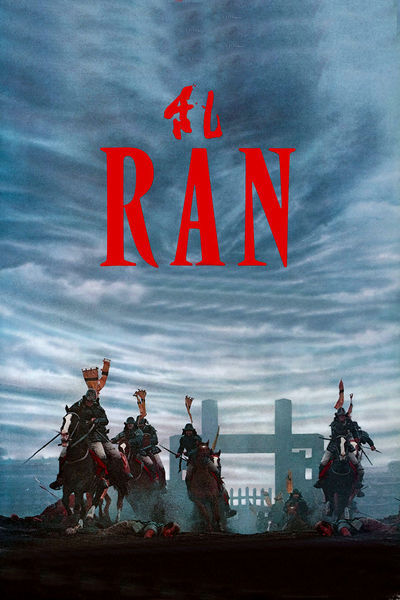
But, in Kurosawa's own words, "Kagemusha" was merely a set-up for his next film, a project he had worked on since "Red Beard," and would bring together the scale and size of films like "Seven Samurai," the atmosphere of "Kagemusha," and the personal turmoil that Kurosawa had experienced for over twenty years - his magnum opus "Ran."
Set in medieval Japan, during a time when waring factors would endlessly fight over land, a young shogun HidetoraIchimonji rose to power, collecting the armies of his fallen foes. For fifty years, Ichimonji fought and conquered the majority of Japan. Now, Ichimonji (TatsuyaNakadai) has reached an old age and is content with keeping peace throughout his land. He figures that his three sons feel the same way, and that is why he splits up his territories and powers among his sons, hoping that this will make everyone happy.
Turns out Ichimonji was wrong. Very wrong. He had forgotten that his sons grew up in a time of constant war and death, always seeking power and greed. Now his sons plan to fight among themselves to claim ultimate control over the land, while Hidetora watches his empire crumble right before his eyes.
Many have pointed out that "Ran" is a Japanese adaptation of Shakespeare's "King Lear," only replacing Lear's three daughters with sons. Kurosawa actually debunked this early on, saying it is merely a coincidence that "Ran" turned out a lot like "King Lear." Kurosawa said that his biggest inspiration for "Ran" was of a real Japanese shogun who gave his land to his three sons, and everything turned out for the better. Kurosawa then asked himself, "What if those three sons were actually bad people?"
There is an analogy early on in "Ran" where Lord Ichimonji has his sons each break an arrow, which they all do with no problem. Then he tells them to break three arrows bundled together, and none of them can break it. Ichimonji does this to prove that it is more difficult to break something when it has support from others, and that if his sons worked together, no one could defeat them.
Kurosawa said he heavily disagreed with that analogy. That there are plenty of ways to break three arrows, and that a family bond can be broken just as easily.
In Japanese, "Ran" translates to "chaos." An accurate description to this film, as we witness literal hell on Earth. Something that started off so simple and kind, quickly turns to brother killing brother, abandoning loved ones to acquire more power, and bloody battles that lead to massive castle getting burnt to the ground.
Lord Ichimonji witnesses all of those happen around him. From the beginning it is strange, as the new lord Taro, demands that his father give back the family crest and that he is in charge of every decision the kingdom will make, showing zero respect for the legacy of his father. After that, Taro outlaws his father's best troops from going along with him, to show Hidetora has gone insane in his old age and is no longer fit to rule anything.
Which leads to one of the greatest sequences I've ever seen, as Hidetora takes refuge in his last remaining castle, only for his two eldest sons, Taro and Jiro, to converge on him and assault the castle. Hidetora's troops are caught off guard and are overwhelmed by the stream of blood-red and sun yellow soldiers that continually enter the castle gates.
This isn't a war, but a massacre, as each body is rattled with arrows and musket bullets. One of the few survivors lies on the ground, holding his severed arm. Hidetora's concubines commit seppuku on each other, while hundreds of troops begin shooting the castle with fire arrows, setting the stone fortress ablaze. All while Hidetora sits atop the tower, watching his fifty-year legacy get reduced to ash.
The assault on the castle is complimented by the lack of any sound effects for the first half, only a haunting score that demonstrates the chaotic nature of Hidetora's senile decision to bring peace in a time of war and control. We are left with nothing but the strong visuals of bodies being brutally destroyed. No computer effects were used in "Ran," so when Hidetora walks out of that burning castle, every bit of it was real.
A reoccurring theme throughout "Ran" is the Gods that are watching all of this unfold. That these Gods either fell tremendous sadness for not being able stop man's self-destructive nature, or that there are no Gods at all. What kind of God would let a man so insistent on peace and prosperity watch his dream and empire fall apart? One of the most common shots throughout "Ran" is of large clouds, or the sun barely breaking through those clouds, as if the Gods are attempting to watch the horror unfold.
But what gives "Ran" its staying power are the resemblances between Hidetora and Akira Kurosawa. Both are men who have lived long fruitful lives, have seen large amounts of success and failures, and have essentially built empires. Yet when they least expected it, the world turned on them. Hidetora's sons betrayed his trust and disrespected him, while Kurosawa was forgotten by the Japanese film industry. Both are forced into exile, forgotten by the world for all the great things they had done. They even both attempt suicide and fail at that.
HidetoraIchimonji is Akira Kurosawa. All his hopes, dreams, failures and personal tragedies are put on full display for the world to see. We watch as Hidetorais reduced to a quivering mess of a man who would rather pick flowers than face the trauma of his decisions, driven into senility. Kurosawa made "Ran" when he was 75, after dealing with 20 years of filmmaking exile in his home country. One of the greatest filmmakers of all time, unable to create his dreams.
Hidetora has more in common with Kurosawa than he does with King Lear.
In my look at John Carpenter's "The Thing," I mentioned there was one film that scared me more than that horror film. "Ran" is that movie. While I would certainly hesitate to call "Ran" a horror film, it is horrific in its tragic imagery. To watch Hidetora, a once powerful man with hundreds of thousands of troops at his command, be reduced to a walking ghost, powerless to stop everything he built from collapsing, is haunting to witness.
"Ran" is one of the greatest tragedies I've seen, complimented by a beautiful color palette that makes every shot of Hidetora stand out. Most of the background are drab and colorless, like rocky terrains, but the blood remains bright red and are impossible to miss because of the unimpressive backgrounds. But ultimately, "Ran" is about an old man who has seen enough war that he believes he can influence the next generation, unaware that life is constantly changing and will tear his weakness and kindness.
This is the martial-arts equivalent of "Rocky 4." Even down to an ending speech from the protagonist about how he hopes his actions can help people change.
"Ip Man" was one of those rare martial-arts films that understood the simplicity of the genre, yet still managed to make these actions feel grand and meaningful. Along with "The Raid: Redemption," those two films were the best martial-arts movies since the days of Bruce Lee and Jackie Chan.
The plot follows up on the events of "Ip Man," as our titular character (Donnie Yen) has fled to Hong Kong and intends to open up a new martial-arts school for his style of fighting, Wing Chun, combining defense and attack into one fluid motion. The film follows the conflict of getting the school running, fighting off rival schools and a climax against an English boxer who will fight any Chinese challenger to show the "superiority" of the United Kingdom.
Part of the appeal comes from these being based on true events. While I don't deny that Master Ip did fight an English boxer, I do find the film's portrayal of these events to be less than satisfying. Most of the events throughout the first half of the film do not amount to anything.
Master Ip has a friend who can't remember anything that wanders the streets of Hong Kong, and we see him bring his friend food every once in a while. But this plot thread leads no where, as we don't even see one last meeting between the two. This is one of many scenes that add little to the film.
"Ip Man 2" tries to add too many new characters and plot details to the simple story of the first film, which soils the great moments. While the martial-art scenes are fun to watch, as always, this one left me feeling hollow and unsatisfied.
No matter how much we learn and try to be better people, humans beings often end up making the same mistakes and fall into the same holes repeatedly. We can try our whole lives to be the moral and good-hearted people we possibly know, yet we will often fall prey to pride, envy, lust or especially greed. Because there is always room for more.
Have you ever wanted something so bad that you’d be willing to do anything to get it? That's being greedy, even if you have a good reason to do so. Granted, most people feel this way when they’re young and desire a new toy or their favorite box of cereal, even though their mother says it’s bad for them.
What if you were an American living in 1920s Mexico, shortly after the Mexican Revolution, and you have little more than the clothes on your back? This is the dilemma in John Huston’s 1948 film "The Treasure Of The Sierra Madre." A film that is told more in the style of a Joseph Conrad novel, where each scene acts as a small adventure that adds to a larger scale of the world these characters inhabit, all while we watch their humanity and souls get devoured by greed and paranoia.
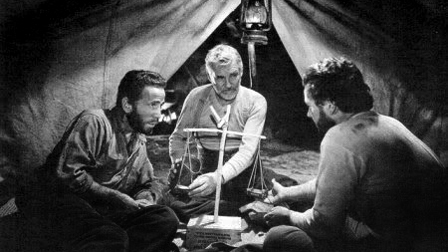
The film starts in a bustling Mexican city, where Fred C. Dobbs (Humphrey Bogart) asks every American he can find to pay for his next meal, which ends up being the same guy three different times. Dobbs uses the money to buy a trip to the barber shop and as much whiskey as he can get his hands on. By the end of the day, he’s flat broke again and finds Curtin (Tim Holt) at a homeless shelter, where the two meet Howard (Walter Huston), a grizzled old prospector itching to go out exploring for gold, as he goes on about why gold is so valuable.
"A thousand men, say, go searchin' for gold. After six months, one of them's lucky: one out of a thousand," says Howard. "His find represents not only his own labor, but that of nine hundred and ninety-nine others to boot. That's six thousand months, five hundred years, scramblin' over a mountain, goin' hungry and thirsty. An ounce of gold, mister, is worth what it is because of the human labor that went into the findin' and the gettin' of it,"
Dobbs and Curtin discuss what Howard had to say, that gold will make good men do evil things. "I know what gold does to men's souls," says Howard.
But the two men agree that it couldn't be true for everyone. That it all depends on the type of person and how greedy they are.
The next day, Dobbs and Curtin find work helping a "wealthy" Texan build houses. When it comes time for the Texan to pay up, he bails out and refuses to pay a cent to anyone. Dobbs and Curtin find this man in a bar and beat him to within an inch of his life to get the money that was coming to them.
All this time, the words of how avarice only affects certain men running through our minds, as Dobbs and Curtin nearly kill a man to get their money. And yet, the fascinating part is that we can't really blame them. They spent almost a month building houses in the hot Mexican heat, sometimes working twenty hours a day, and had nothing to show for it.
Shortly after that, Dobbs and Curtin find Howard and agree to use their money on something useful - going into the mountains to find gold. The three put up all of their money to buy the necessary supplies, food, water, mules and guns to go hunting for the treasure of a lifetime in the high mountains of the Mexican terrain.
At the beginning of the film, Fred Dobbs seems like a guy trying to make a living in a difficult situation, being stuck in a foreign land with no money. Dobbs says that he won't need much money out of this trip and he'd be okay with getting $10,000.
It isn’t until the signs of gold start to appear that Dobbs takes a turn for the worst. After their first full day of work, he immediately asks to start splitting the gold into three even piles, and that each man should be responsible for his own stash, including hiding it from the other two.
"This is the country where the nuggets of gold are just crying out for you to take them out of the ground and make 'em shine in coins on the fingers and necks of swell dames," says Dobbs.
When Curtin accidentally stumbles across Dobbs' hiding spot, Dobbs nearly shoots Curtin for stealing, even though Curtin was only interested in killing the Gila Monster that had crawled under that rock. Even after learning the truth, Dobbs still wants to beat up Curtin for even thinking about going near his money. Though Curtin saved Dobbs' life earlier from a cave-in, and Howards' knowledge of the area being the only thing that got him to this mountain, Dobbs refuses to trust anyone.
The man that was relatable at the beginning of the movie has turned into a twisted greedy and sort of evil caricature of his former self.
"I think I'll go to sleep and dream about piles of gold getting bigger and bigger and bigger," says Dobbs.
The thing that suddenly makes "The Treasure Of The Sierra Madre" scary and intense is that Dobbs' transformation into this monster is realistic and feels like it could happen to anyone if they were put in similar situations. Separated from society, collecting thousands of dollars every day, with two other people as your companions, but also their own self-interests. What do you do?
"The Treasure Of The Sierra Madre" offers three answers to this question with the main characters. Dobbs has become nothing but greed, to the point of risking all of his money to see if Curtin would fall asleep before him. Always wanting more and insisting on lavish rewards when he returns to society.
Curtin, however, is kind and logical about all of this. He was the only one to oppose splitting up the gold at the end of each day, because he didn't see the point in it. Curtin also risks his life several times to protect others instead of his interests. He doesn't mind if the trip takes a little while longer and if he has to deal with a paranoid partner, as long as he gets what is coming to him.
Howard is the middle man who sees both sides of argument, because he has been there. He has been Dobbs, never satisfied with the gold he has and always hankering for the chance to get more. But he has also seen gold destroy his friends and has probably done so a few times himself. He's experienced those hardships and has come out stronger.
Yet all three men remain believable. The audience relates to Curtin for remaining calm in this situation, respects Howard's knowledge and fears what might become of Dobbs. I would say we're supposed to pity Dobbs for how selfish and pathetic he could be, especially near the end, if Dobbs wasn't so undeserving of pity.
The scene that personifies this feeling is when one of the three gold hunters must to go into a nearby town for supplies, but none of them are willing to go, especially Dobbs. He’s afraid that if he goes, this will give the other two ample time to find his stash of gold. Howard points out that he should take his gold with him then, but then Dobbs becomes paranoid about the lurking murderous bandits nearby and that the gold would only give them more of a reason to rob him.
"If you was to run into bandits, you'd be out of luck anyway. They'd kill you for the shoes on your feet," says Howard.
Dobbs replies with, "Oh, so that's it. Everything's clear now. You're hoping bandits will get me. That would save you a lot of trouble, wouldn't it? And your consciences wouldn't bother you none, neither."
By the end of the film, Dobbs reflects on some of the terrible actions he has done to get the gold that he feels rightfully belongs to him, leading to a soliloquy that is still haunting today as it was in 1948.
"Conscience. What a thing," says Dobbs. "If you believe you got a conscience it'll pester you to death. But if you don't believe you got one, what could it do t'ya? Makes me sick, all this talking and fussing about nonsense."
"The Treasure Of The Sierra Made" had many complications while being filmed. Originally an idea John Huston wanted to film in 1941, based on the novel by B. Traven, Huston waited until after World War II and filmed it deep in the jungles of Mexico, during the middle of the summer, and still went massively over-budget and took longer to film than expected.
Yet Jack Warner, the producer of the film and co-head of Warner Bros., was still willing to let Huston continue to make the film his way, because he believed what they were making was "definitely the greatest motion picture we have ever made."
While it took more than seven years to make "The Treasure Of The Sierra Madre," the result was a film with diverse yet interesting characters, a tight and focus story with a crisp and realistic approach, balanced and superb acting from the three main cast members and a message that spoke directly to the human condition of greed and paranoia. A film that wasn't so much about gold or the adventure to the gold, but the characters who set out for a fortune and instead found hardships and tragedy.
By the end of this film, we are as wise as Howard about what gold does to men's souls.