Wednesday, July 15, 2015

Paul's Favorite Films - Number 13


I did not have many nightmares as a child, but the ones that I do remember were some of the most painful memories I have. They were always ones of situations that I had no control over, as I watched my life zip right passed me, and being forced to make life or death decisions. Like being trapped in a car teetering on the edge of a collapsing bridge, or realizing that your airplane's engine is on fire. Nightmares stick with you long after you've dreamed them, sometimes more than your pleasant dreams.

Now imagine an entire film that feels like a nightmare.

A film that makes you feel vulnerable, helpless, out of your element and absolutely petrified. The film would not play with your emotions, but feast on your deepest and darkest fears. You'd think a film like that would be different for everyone, but Charles Laughton's "The Night Of The Hunter" finds a way to make the audience feel as though it were a child being preyed on by a beast that will stop at nothing to sink his teeth in your throat. This is accomplished through many ways, but in particular it is the casting and some of the best black-and-white cinematography.

During the great depression in West Virginia, local farmer Ben Harper (Peter Graves) promises to never put his children on the street without food in their belly, and ends up robbing a bank for nearly $10,000. As he makes it home to his family, he quickly finds a place to hide the money and makes his children, John and Pearl, swear the two will never show the hiding place of the cash, and that John will always protect Pearl. Ben is then taken by the cops and sentenced to death, after killing two men to get the money.

But while sleeping in his jail cell, Ben lets it slip that the money is still out there, and his cell mate, Reverend Harry Powell (Robert Mitchum) takes advantage of this upon his release and makes it his mission in life to hunt down the money at whatever the cost, even if that means having to deal with Ben's wife, Willa (Shelley Winters).
night_of_the_hunter

"The Night Of The Hunter" contains elements that you'll be seeing a lot of when we reach my top ten - A scary other-worldly villain, and breath-taking cinematography.

Let's start with what most people remember about "The Night Of The Hunter," Robert Mitchum and his performance as Harry Powell. To me, this is Mitchum's best performance, in a long career of superb roles. Mitchum was at his best when terrifying our cast of characters, and stopping at nothing to get what belongs to him, in his warped mind anyways. In this film, he stalks, berates and creeps on a desperate and poor family, to the point that the mother succumbs to his charm and silver tongue and marries the man, just so that he can get closer to the money.

The way that he pronounces "children" always sends shivers down my spine, as he takes extra care to emphasize the "chill" part. It also doesn't help that he keeps calling these children "little lambs."

the-night-of-the-hunter

The most defining physical trait of his character are the words "love" and "hate" tattooed on his knuckles, long before it was considered popular and cool by other people. In this case, Powell uses these words to tell the story of good and evil, just to get closer to the people he wishes to use. He uses his words strategically and maniacally, with his kind words being able to swoon anyone into loving his pleasant and helpful demeanor, while his hateful words are like a knife stabbing at you long after you've left this world.

He sees himself as a wolf, here to help those little lambs from themselves.

But the absolute scariest part of this character, and what makes him one of the most terrifying villains in all of cinema, is that he is a man of God, a preacher. He quotes verses from the bible, profuses his love for Jesus, and tells the tale of good and evil with his hands, just so that he can kill people and steal their money. He uses God to do horrible crimes of passion and self-interest.

When asked what religion he preaches, Powell responds with the religion that he and "The Lord" worked out betwixt them. In fact, you can hear his arrival to any scene with a rendition of "Leaning On The Ever Lasting Arm," but removing any mention of Jesus, making him all the more menacing.

Reverend Harry Powell is the perfect antagonist to these small children. He has everyone in town on his side, due to his ability to win over any religious folk, but shows no remorse or kindness, and will stop at nothing to get that money. Even when the children on the run and sleeping in a barn, Powell catches up to them in the middle of the night, where John comments on how he must never sleep or eat.

Night-of-the-Hunter

He is the monster in your nightmare that will never stop or get tired, and the only thing he thinks about is chasing you down.

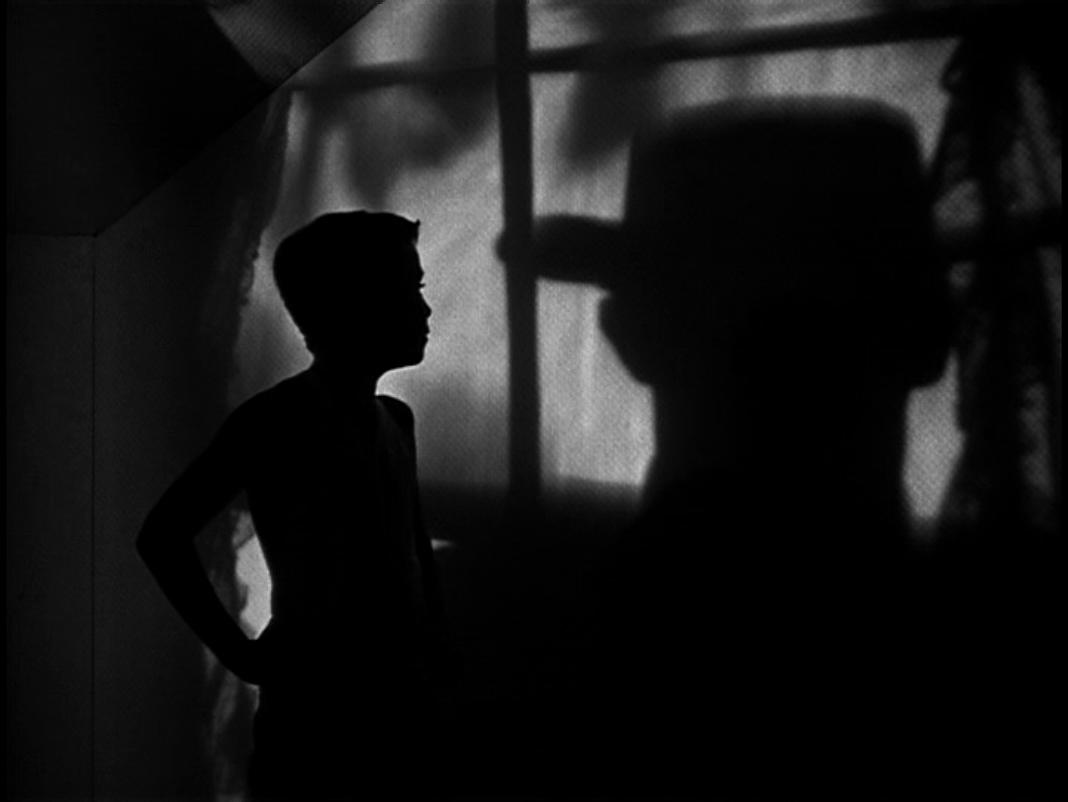
To compliment the absolute terror of Harry Powell, "The Night Of The Hunter" also offers cinematography that is better than most films today, adding to the nightmarish quality to the film.

Aside from the creepy darkened houses with a virtually blank black wilderness behind them, as if they exist in a void, the gothic angles and proportions of the houses are eerie and wildly jagged, like something out of a German expressionist piece. For example, in a key scene with Mitchum and Shelley Winters, the angles of the room make a tiny house, with the vertical ends at strange angles, yet still confined and restricted. Yet Winters sleeps on a bed that is out of house and exists in a black void and almost out of reality.

night-of-the-hunter-1

During the outdoor scenes, which always take place at night, there are many source of light coming from unnatural places, as though there are multiple moons in the sky. To add to this creepy factor, there is an emphasis on small soft animals while the children are around, like rabbits, mice and frogs, and deadly predators like owls when Powell is lurking.

This gives "The Night Of The Hunter" its nightmare effect. Everything is oddly shaped and unrealistic, as if this world should not belong. Yet here is this man who uses the word of God to kill innocent people, and has the words "love" and "hate" on his hands. These children are trapped in a world where they are hunted down for something they didn't do, in a world that even Dr. Seuss never thought of.

disque-la-nuit-du-chasseur108

If that isn't a nightmare, I don't know what is.

The director of "The Night Of The Hunter" was Charles Laughton, who was known for is roles in "The Hunchback Of Notre Dame" and "Mutiny On The Bounty." This is also the only film Laughton would direct, and it is a gem of black-and-white filmmaking. It uses negative space and emptiness to its advantage, while having an unrelenting atmosphere where you are unsure if even God is on your side. Add an unsettling performance from Robert Mitchum, and you have a film that makes you feel trapped in unforgiving nightmare.

night-of-the-hunter

Monday, July 13, 2015

Mini-Review - "The Shop Around The Corner" (1940)

The_Shop_Around_the_Corner_-_1940-_Poster

I can see why this film would eventually become a great stage play - most of this takes place in two or three locations, there is a great emotional pull-line throughout the film that leads to some witty banter and has a colorful cast of characters that add to the feeling of community.

Part of what makes this film internationally famous is that it takes place in Budapest, yet everyone speaks perfect english. Even the main stars, James Stewart and Margaret Sullivan seem like they fit in America, yet no one bothers to hide behind any sort of nationality.

One of the important points I found in "The Shop Around The Corner" was the key differences between the way men and women think. There is a key scene where the employees of the shop discuss an item they have an abundance of - a cigarette box that is also a music box. The men think it is a terrible idea, since if you smoke a lot, you must listen to that song a lot, whether you want to or not. While the women believe that others will find the tune enjoyable, and it'll make smokers into music lovers, and music lovers into smokers, which is great for business.

This comes into play throughout the entire film, as we see James Stewart be practical and logical, while Margaret Sullivan is emotional, honest and true to herself. The two constantly butt heads over their different perspectives, but there is a genuine need to care for one another. They hate one another, but they make each other better people.

"The Shop Around The Corner" is an emotional little slice of life that perfectly captures the comradery between fellow employees and the family that builds between them, while also giving us a neat perspective on the differences between the sexes, which was unheard of in the 1940s.

Final Grade: B+

Sunday, July 12, 2015

Mini-Review - "Miami Connection" (1987)

miamiconnection_poster-final__small

I cannot wait for the Rifftrax of this one.

In case you have never heard of this gem, let me give you a brief description - The film does not actually take place in Miami but Orlando, it follows a rock band named Dragon Force, a bunch of orphaned teenagers that all know Tae Kwon Do, except they're not orphaned since at least two still have their fathers, and they play a shady club owned by another master of Tae Kwon Do. A rival band is upset they can't play at this club, always screaming that it is bullshit even after Dragon Force gives logical explanations, and they end up calling in a gang of motorcycle ninjas to take down Dragon Force once and for all. Oh, and roughly 45 percent of the movie is the band performing songs about friendship and kissing ninjas.

"Miami Connection" does not take itself seriously, and neither should you. One of the better "so bad, it is good" movies I have seen in a while. Get a couple of friends and some beers, sit back and enjoy the stupidity.

Final Grade: C+

Friday, July 10, 2015

Paul's Favorite Films - Number 14


James Stewart and John Wayne in a film directed by John Ford. Best screen combination ever.

Leading up to this little known western, "The Man Who Shot Liberty Valance," both Stewart and Wayne had developed an outstanding body of work in their respective genres. Stewart was the every-man in many screwball comedies like "The Philadelphia Story," or helping Frank Capra make poignant emotional pieces, as we've seen previously with "Mr. Smith Goes To Washington." Wayne, however, was Mr. Western. He was known to "react, not act," which lead him to become a leading man who felt the same in life as he did on screen - what you see is what you get.

Both were beloved and respected by nearly everyone, but for entirely different reasons. Wayne and Stewart had their share of similarities, such as their drive and dedication to cinema and their overwhelming screen presence, but besides that these two are night and day. They came from different schools of acting, they played contrasting roles and it seemed like they lived on two different planets.

After the end of World War II, James Stewart entered in a new film contract. Previously, he had been stuck in the same types of roles where he played kind but passionate men, and he wanted to change that image. This led him to make four movies with Alfred Hitchcock, a slew of westerns, and roles where he would play more stern and dominate characters, like in "The Flight Of The Phoenix."

One of these films was "The Man Who Shot Liberty Valance," which allowed him to work with the iconic filmmaker John Ford, who popularized the Western genre. Basically, any major Hollywood western that came out between 1939 and the late 1950s was directed by Ford, including "Stagecoach," "My Darling Clementine," "Fort Apache," "The Grapes Of Wrath," "Rio Grande" and "The Searchers," and almost all of them starred John Wayne. Ford was also known for influencing countless filmmakers, including Orson Welles, Martin Scorsese, Steven Speilberg and Akira Kursoawa.

Ford is the binding agent that holds Stewart and Wayne together, by bringing their contrasting styles and personalities together, to give us a western that is both bittersweet yet satisfying, as we watch the old west fade away and give birth to modern civilization.

Senator Ransom Stoddard (Stewart) has just arrived in the growing town of Shinbone, to attend the funeral of an old friend, Tom Doniphon (Wayne). The local paper is intrigued by this, so Stoddard reflects on his young adventure from decades ago, as a young Stoddard arrives in Shinbone by Stagecoach and is attacked by the town's biggest threat - Liberty Valance (Lee Marvin). Stoddard insists on using law and order to put Valance behind bars for his crimes, much to the laughter of Doniphon, who says the only way to deal with Valance is with a gun.

libertyvalance2

Aside from Stewart and Wayne in this film, "The Man Who Shot Liberty Valance" has a massive all-star cast, all of which turn in a stellar performance - Vera Miles, the previously mentioned Lee Marvin, Edmond O'Brien, Andy Devine, John Carradine and even a young Lee Van Cleef.

What stands out about "The Man Who Shot Liberty Valance" is how different it feels from any other John Ford western. In films like "Stagecoach" and "The Searchers," there is a distinct feeling of the outdoors and vast landscape of the west. But "The Man Who Shot Liberty Valance" feels enclosed and trapped. Part of this is because most these scenes take place either indoors or on a sound stage, instead of a western town built outside.

Normally, this would be a bad thing for a western, as it would make the film feel artificial and remove the feeling of braving a vast frontier. But in this film, it plays to the themes of the west dying. That there is only so much room for this old way of life to move that it is beginning to suffocate.

waneandstewart

Ultimately, "The Man Who Shot Liberty Valance" is about the lawless western lifestyle against the sophisticated and orderly eastern way of living clashing, with James Stewart representing the east and John Wayne doing what he always does for the west. Stoddard is literate, educated, wishes to pass this knowledge onto everyone else, and is against violence, preferring to use justice to solve those problems. But now he lives in a world that doesn't understand justice or law and order, where whoever has the fastest gun is top dog and the local sheriff sleeps in the only jail cell.

Doniphon insists to Stoddard that Liberty Valance will kill him unless he either leaves town or learns to use a gun, but Stoddard firmly believes in law and order that he is willing to lay down is own life to protect it. The sheriff won't protect Stoddard, and Doniphon keeps his strength hidden until he absolutely has to use it.

Liberty Valance stands in the middle of this, as he represents the tyranny of the old west. Everyone in Shinbone is afraid to him, and petrified to stop him from his continued antics. The only one who could is Doniphon, but he is too focused on getting the girl of his dreams, Hallie (Vera Miles). He is building an extension to his house to give Hallie a place to live once he proposes to her. The problem is that Stoddard offers Hallie something new - education.

TheManWhoShotLibertyValance

So does Doniphon let Liberty Valance take care of Stoddard and secure Hallie as his girl? Or make sure that Hallie leads a happier more educated life with Stoddard, sacrificing his own happiness?

I've talked about this in a previous editorial, but "The Man Who Shot Liberty Valance" is one of the best examples of a fascinating genre - the death of the old west. We all knew this would happen, that the days of cowboys and hired gunmen would give way to courts, towns and civilization. The heroes of the west would die as the railroad advanced, and riding off into the sunset was no longer an option.

We watch as society slowly creeps into this film, but only so slightly that it doesn't seem out-of-place. Newspapers have become a great way of getting information around the territory, town meetings are held with no alcohol being served, education and schools are popping up to people of all ages, and statehood is discussed.

It wouldn't be too long until the untamed west would be cultivated into a beautiful garden.

Yet, at the same time, the east is given enough to learn from the west. Stoddard does have to defend himself against Liberty Valance, and ends up being known as "the man who shot Liberty Valance." In fact, he ends being elected as a Senator because of that title.

This leads to one of the best lines in the film, said by the editor-and-chief of the paper to Stoddard years in the future, "This is the west, sir. When the legend becomes fact, print the legend."

"The Man Who Shot Liberty Valance" not only has one of the best screen pairings with Stewart and Wayne, but gives us a look at the old west that is not often observed. This feels like the west is deteriorating and we see what happens to those old cowboys. We'd like to think they hang up their spurs, but now we see their sadness and sacrifice, to make a better world.

the-man-who-shot-liberty-valance-movie-poster

Wednesday, July 8, 2015

Movie Review - "Terminator: Genisys" (2015) - Why Is It Called "Genisys"?

MV5BMjM1NTc0NzE4OF5BMl5BanBnXkFtZTgwNDkyNjQ1NTE@__V1_SX640_SY720_

I don't talk about this as often as it should be mentioned, but plot holes can ruin a movie. In most of the films I watch, there are few holes in the story or gaps in logic and train of thought that it does not deserve to be mentioned, or the holes are simply not that noticeable. But then there are films where the film does whatever it wants to do, believing that the audience will go along with it, forgetting that it destroys the story and makes no sense at all.

For example, "The Dark Knight Rises" is full of plot holes and inconsistencies, like how Talia Al Ghul was able to escape the prison at an incredibly young age, yet no one else was ever able to do it until Batman, or that no one would notice the supposedly dead Bruce Wayne running around Florence, and that Bruce Wayne happened to die the same day as Batman.

As I've mentioned in the past, the more you think about the story and logic of "The Dark Knight Rises" the more it falls apart.

Perhaps the reason I don't concern myself with plot holes is because I don't often like to think about why certain events happen unless the film wants me to notice it. That I shouldn't worry about things like food or characters going to the bathroom, because it is just a movie. But then there are films that forget their own continuity and go all over the place, bending time and space to their whim to the point that it is simply baffling.

When a film wants to be logical and sophisticated, but ends up as chaotic and stupid, that is when plot holes deserve to be mentioned.

One such film is the most recent entry in the Terminator franchise, "Terminator: Genisys" a franchise that has been slowly but surely loosing steam since creator James Cameron left after the second film, probably because the story was complete and there was nothing left to accomplish. Instead, we get this new film that misses the driving factors of faith in the face of an insurmountable future, and the strong-willed characters that we wanted to see pull through, to give us a forgettable science fiction mess that doesn't even begin to make sense.

In the year 2027, the computer program Skynet has taken over the world by wiping out most of the human race with nuclear bombs, leaving a small platoon of rebels to fight against an army of machines. Just when it looks like Skynet is about to lose, the machine uses its "last hope" to win the war, by sending a Terminator back in 1984 to kill Sarah Connor (Emilia Clarke), the mother of the leader of this resistance, John Connor (Jason Clarke). But the rebels send Kyle Reese (Jai Courtney) to protect Sarah from the Terminator, only to find that the time he has been sent to is very different from what he expected.

maxresdefault8

First off, let's set the ground work for time travel by "Genisys" standards - This film believes in the multi-verse theory. That, when you travel back in time, you are actually being transported to an alternate universe. You no longer exist in the same time line, and thus a different world altogether.

Except that time travel has never worked like that in any of the other Terminator films. It has always been one consistent time line, where if you travel from the future to the past, and make changes, those have an affect on the future. There is no other universe theory, only that time flows like a river upstream- you make enough ripples in the past, and it might affect the flow of the current in the future.

So already, we have a huge inconsistency in how time travel has worked compared to earlier films. It also ruins the "there is no fate but what we make for ourselves" phrase that the Terminator films love to use.

That's like the Star Trek films throwing out "the needs of the many, outweigh the needs of the few" line they love so much. Oh wait, that happened in "Star Trek: Insurrection."

But wait, it gets worse.

landscape-1428935780-terminator-genisys-arnold-smile

From the opening scenes, "Genisys" makes it clear that Skynet was still developing the time machine when it was used to send the Terminator back to 1984. That it only had enough power at the time to send one Terminator back and no more, and that only one object can be sent back at a time.

Yet, over the course of the film, we found out that not just one or two machines were sent into the past, but at least five robots were sent back in time, including two T-1000s and the highly experimental T-3000. So how exactly did Skynet send all these back into the past, when it only had enough time and energy to send one? Why did it need to send all of these back in time? Why not just send them all back to 1984 and overwhelm the one T-800 protecting Sarah Connor, who doesn't know how he got to the past or who sent him back (another plot hole).

But you can't send more than one thing per trip. Except when Kyle Reese and Sarah Connor travel from 1984 to 2017, together, in the same time bubble. That is baffling beyond reason. So Skynet could do the same thing all along? Why not just send an army of Terminators into the past? Why bother only sending one when it seems like one is so easily defeated? Why did John Connor only send Kyle Reese into the past, when nearly every one of his soldiers volunteered to go back? They clearly all could have gone if they crammed into the bubble.

This film keeps ignoring and disregarding its own rules on time travel and messing with the past that it hurts just thinking about all the holes.

Oh yeah, Sarah Connor and the Terminator that raised her were able to build a fully functional time machine in 1984, despite not having the proper technology, resources and less than ten years to build it, while Skynet had probably been working on it for over twenty years. I call bullshit on the highest order.

7trwihFwf5Ex

I could spend the entire day talking about all the plot holes and inconsistencies in "Terminator: Genisys," but suffice to say these do bring the film down. It is hard to get connected to these characters and care about anything that is going on, when the writing ignores logic and is all over the place.

Speaking of the characters, "Genisys" attempts to bring back the same ferocity and drive of characters like Sarah Connor and Kyle Reese, but misses on almost every note. Kyle Reese has zero development throughout the film and makes no attempt to show us why he should have been sent back to 1984, other than what John Connor told him about the past, which goes against the biggest rule of filmmaking - show, don't tell.

All we know about Kyle Reese is that he can shoot a gun well and has an awkward romance with Sarah Connor.

As for Sarah, she was the biggest disappointment in this film. In "The Terminator" and "Terminator 2: Judgment Day," Sarah Connor was fiercely independent, strong-willed and was more than just a good shot. But here, she always relies on the support of other men, and cannot seem to do anything without "Pops," her nickname for the Terminator sent back to protect her. To the point that she is immobilized when "Pops" might be dying.

One of the greatest female film characters of all time, reduced to a glorified damsel in distress, always needing a savior.

In fact, that might be the biggest reason for why I hated "Terminator: Genisys." I could look passed some of the plot holes and the many unnecessary references to earlier Terminator films, but this film forgets every reason the first two films are so loved. This film thinks that we love it for guns, robots and explosions, when in reality, it was the characters and the relationships they built. Even though these people knew about the terrible future ahead of them, they fought on to make a better world, no matter what those sacrifices were. They always had this heavy burden that they alone must carry, seeing tragedy where others saw hope.

"Genisys" exchanges those deeply concerned and motivated characters for people who are here to shoot loads of bullets into a robot that will just keep on coming back for more. I can only think of one word to describe that type of absurdity: weak.

Final Grade: D+

Friday, July 3, 2015

Mini-Reviews - "Rubber" and "All-Star Superman" (2010)

Rubber-2010-film-poster

"Rubber" (2010)

Even if you've never seen this film, you probably heard of the premise and how it is utterly ridiculous - A tire comes to life, learns that it has psychic powers and becomes a serial killer.

While watching "Rubber" my reaction was the same as it was while seeing the trailer - Huh?

I don't know how else to describe it - This is a film about a killer psychic tire. How can you respond to that other than massive confusion?

To the films' credit, they do attempt to explain why it is not that baffling, with an opening narration from a police officer, as he tells the audience watching the tire come to life, that a lot of great moments in cinema happen for "no reason" like why the aliens in "E.T. The Extra-Terrestrial" are brown or why in "The Pianist" Adrien Brody has to live in the slums and use his talents to buy a nice house. Of course, there are reasons for why these events happen, but it does offer a different perspective, some people don't think about why they happen.

"Rubber" lives in its own little world, where it constantly reminds the audience, both the one watching the film and the other in the film watching the "film," that you're not supposed to think about why the tire is alive and how it got these powers. To look beyond that gap in logic and reason, and judge the film as piece about new life discovering its place in the universe.

I'm reminded of the ending to the "Mystery Science Theater 3000" theme song - "If you're wondering how he eats and breaths, and other science facts, then repeat to yourself 'It's just a show, I should really just relax.'"

That being said, the tire, somehow named Roger, seems intent on killing all humans.

"Rubber" is a strange piece of surreal cinema. Without breaking the fourth wall, this gives us a film within a film, where you're not exactly sure where the acting ends and where "reality" begins. It is never even explained why there is an audience in the middle of the desert watching this first, and why none of them brought food or water. But this film does a great job and showing instead of explaining, down to the convincing effects on the tire to give this inanimate object its own character.

There aren't many films that can say they've made a tire come to life and make it look realistic.

Final Grade: B-

AllStarSuperman

"All-Star Superman" (2010)

This is a very simple, straight forward Superman about the misadventures of the Man of Tomorrow, as he finds out that he is slowly dying and wants to make the most of the little time he has left.

It takes advantage of the reason Clark Kent became Superman - to show people the way to lead a better existence. Superman could easily enforce his will on Earth and take it over, but he choose not to. He instead shows us kindness, forgiveness, and knowledge, never asking for anything and reminding us that we don't need super powers to become better.

Not much else to add to that. Most of the journeys and fights in this film are unconnected and to the point, including a visit from Samson and Atlas to fight the Ultra-Sphinx, Lex Luthor fighting his way through a massive prison while Superman (disguised as Clark Kent) fights Parasite, and the final battle between Superman and Lex, who has been gifted with Superman's powers for 24 hours. All of them are neat in their own right and it is nice to see a side of Superman that isn't just a guy who punches everything.

Final Grade: B-

Thursday, July 2, 2015

Paul's Favorite Films - Number 15


Of all the films on this countdown, this is the movie that people have probably heard the least about.
The majority of these films are from America and Japan, with all but one of the Japanese films coming from critically acclaimed directors that most non-film buffs have heard of or are Godzilla films. This one is a relative unknown, but that is understandable.

When it comes to World War II, each country has its own interpretation of the events, as well as different feelings on the war. It makes talking about it quite personal, and difficult to discuss without looking it from your country's point of view. In America, we prospered after the war, even though the emotional toll was quite high. New and better technology was invented, the nation grew stronger and united, and we had seen the beginning of the baby boom era.

But what would about countries on the losing side of WWII? How did they fare after the war? Did their economy prosper or falter? How did they cope with the emotional toll? What did they do to survive losing a war?

Of all the films about World War II, Kinji Fukasaku's "Under The Flag Of The Rising Sun," leaves the biggest impact on me, because it takes a unique and stylized look at a side that is so often overlooked - the Japanese side of the war, and the aftermath it had on the Japanese people.

Fukasaku was known for directing films with an eccentric visual style, often using tilted camera angles and color filters, to give his movies a more dream-like state. Fukasaku had one of the longest careers in Japanese filmmaking, as he started in the early 1960s with small B-movies, moving up to direct many Japanese gangster (Yakuza) flicks, handled the Japanese segments of "Tora! Tora! Tora!" (a job that was initially given to legendary director Akira Kurosawa) and would end his career with one of the most outstanding films to come out of Japan, "Battle Royale" in 2001.

While "Battle Royale" is considered his masterpiece, "Under The Flag Of The Rising Sun" is more of a personal piece about the depths man will sink to during war, and how this has a continued effect long after the war has ended.

It has been 26 years since the end of World War II, and every year the Emperor of Japan visits the memorial to the nearly four million Japanese lives that perished during the war, but not all are accepted and appreciated. For example, the husband of Sakie Togashi (Sachiko Hidari) has been dead since 1945, but the cause of his death has been changed from killed in combat to execution, possibly because he mutinied against his superior officer. But because of the confusion at the end of the war, no one can be too sure of the legitimacy of those documents, meaning Sakie has wondered what killed her husband for 26 years and has never gotten an answer.

underflagsun

But thanks to a kind soul in the legal department, she is given the names of four surviving people in her husband's platoon that might be able to shed some light on what happened to him.

I like to think of this film as a combination of Stanley Kubrick's "Paths Of Glory" and Akira Kurosawa's "Rashomon." It has the same despicable and disgusting outlook on war as Kubrick's film, even down to officers executing their own kind for showing basic human traits and emotions in the heat of combat. That in war, we should remove our humanity and soul so that we can best serve our country, when that is impossible.

However, "Under The Flag Of The Rising Sun" has many more similarities to "Rashomon," as both films are about multiple eye witnesses recalling dire and drastic events, yet each person having completely different interpretations and coming to almost opposite endings, leading the audience to figure out which story is true and the others that must be false.

This gives "Under The Flag Of The Rising Sun" its own unique feel, as each story gives us a new perspective on the role that the war has played on the person. How their lives have been effected by it, and how they look back on these traumatic events. While there is room for doubt on each story, there is no hiding that Japan was crippled by WWII and is still hurt by it.

a%20Kinji%20Fukasaku%20Under%20the%20Flag%20of%20the%20Rising%20Sun%20DVD%20Review%20PDVD_012

Japan is a nation dedicated to honor and loyalty to Japan. But in war, honor may mean something on an personal level, but on a grand scale honor and loyalty means nothing. According to this film, the Japanese soldiers believed the superiority of their country and way of life and that would lead them to victory. But as this war continued on, it was clear that it took more than dedication and honor to survive, let alone win.

During the battles that took place on New Guinea, the Japanese had roughly 12 working cannons, all of which were useless pieces of junk. It had gotten to the point where only 45 machine guns remained among the 800 troops, and the rest were forced to make spears out of bamboo against the heavily armed Americans and Australians.

And those were the soldiers that could actually stand up and fight, not counting the thousands of Japanese troops that died on the boats, were lost to the ocean, were never seen again while traveling through the mountains, or had died (or were dying) of starvation or malnutrition. Those rocky mountains had nothing eatable other than a few potatoes that were stolen from local villagers, which the soldiers would naturally fight over.

UnderTheFlagOfRisingSun%20(26)

One point is made clear in this film - In that kind of environment, where supplies are gone, the enemy is beating down on you and you must fight to get even a scrap of food, how can one be honorable and loyal? Is sacrificing yourself to starvation proper to save Japan?

War brings out the disgusting parts of humanity, where "honor" means nothing.

We are given many war stories in "Under The Flag Of The Rising Sun," each more disturbing than the last, but all with a common theme throughout all - the need to survive, and the sacrifices that must be made. Each story has Sakie's husband as the main character, as he steals potatoes from his fellow troops, kills his friends to have something to eat, and plans the murder of his crazy superior officer who has gone mad with power.

Very little of this film is about the Japanese troops fighting the enemy, but rather themselves. Each survivor speaks of very little about what it was like to be in the heat of battle, and instead obsesses about what they were fighting for and that Japan would emerge as the strongest nation. But only to realize that Japan has since turned their backs on their soldiers, even forcing one survivor into a theater comic routine where he is a long forgotten soldier who thinks the war never ended.

undertheflag

This is still a big problem in Japan - the lack of respect for the older generation. Very often, the newer generation seems ungrateful to those who sacrificed their lives so that Japan could continue on. This now massive metropolis and economic power that risen up from two atomic bombs and bureaucratic collapse, insists on looking forward, never backwards. Another survivor is now a school teacher, and often wonders why he sacrificed his youth and innocence when these children don't care about that.

There are many terrifying images in "Under The Flag Of The Rising Sun," most of which are real photographs from the war of destruction and mutilated bodies. This makes the film one of the most brutally honest and unflinching depictions of WWII that I've seen, and certainly falls into its own class by being about a side of the war that isn't often looked at. With hauntingly beautiful cinematography that gives this a nightmare quality, "Under The Flag Of The Rising Sun" a terrifying portrayal of war that deserves much more attention.

220px-Fukasaku_Under_the_Flag_R1_DVD